Converting a road, gravel, hybrid or mountain bike to electric can be a practical alternative to replacing a bicycle that already fits you well. The catch is that a wheel label tells you almost nothing about whether a kit will fit.
Here is the idea most conversion guides miss, and the one this article is built around: the 622 mm your wheel shares with a 29er is the one measurement that does not decide your conversion. The number that does is your axle standard. Two bikes can carry the identical 700C/29-inch label and yet need completely different motors — or, in some cases, no hub motor at all. Get the axle question right first and the rest of the checklist falls into place.
Many conventional 700C and 29-inch bicycles can be converted. Before ordering, you need to identify the real wheel standard, read your axle, choose the motor position and measure the frame. This guide walks through it in the order that actually protects your money.
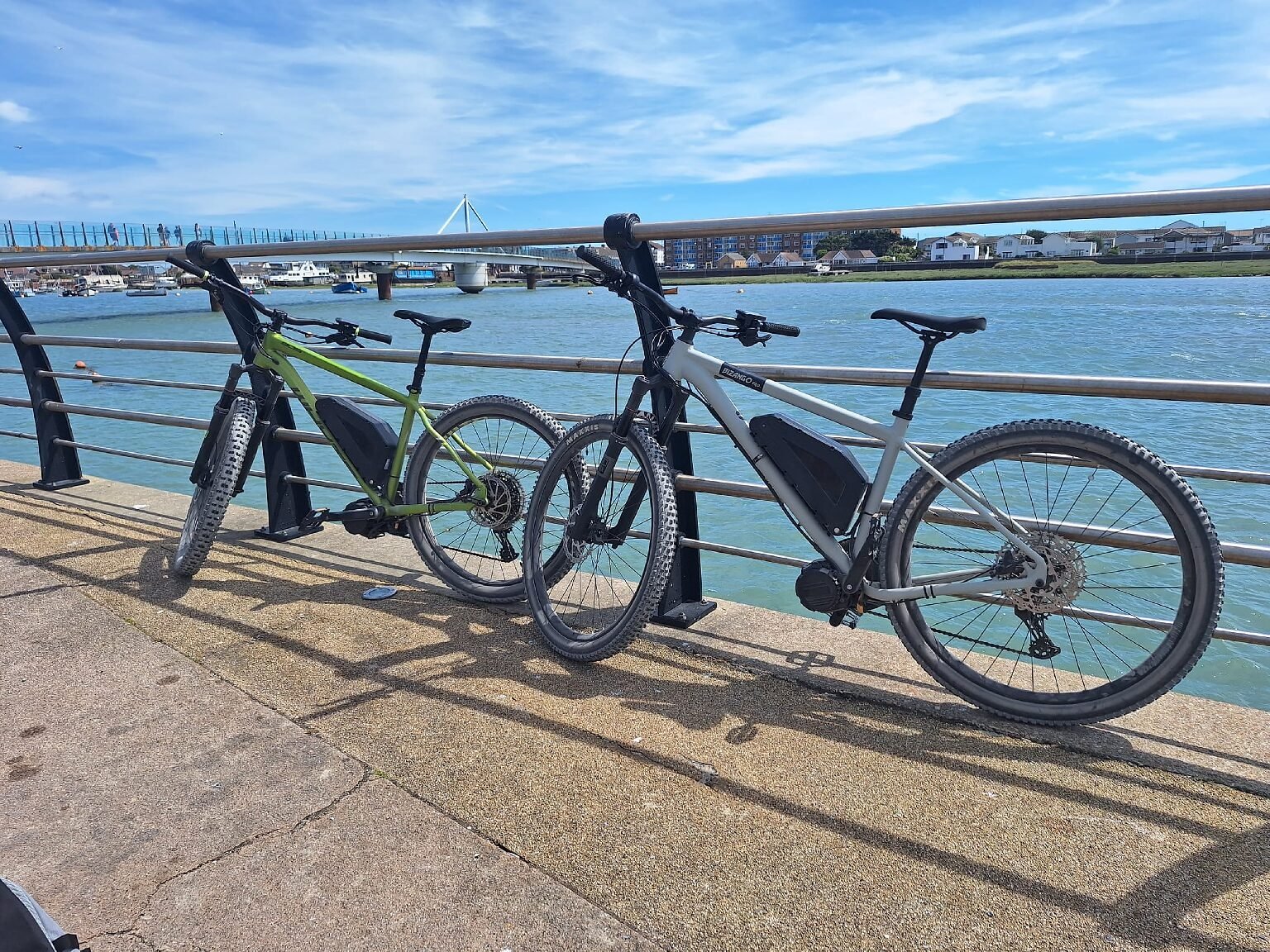
A 29-inch mountain bike is one of the most common conversion donors in the UK — but the wheel diameter is rarely the thing that decides the build. Image: real customer conversions. [alt: two 29-inch mountain bikes converted to electric with frame-mounted batteries]
Are 700C and 29-Inch Wheels the Same Size?
The terms 700C and 29-inch usually describe wheels built around the same 622 mm bead-seat diameter — the diameter where the tyre sits on the rim, not the outside diameter of the inflated tyre. On paper they match.
In practice they are not automatically the same conversion wheel. A typical 700C road wheel uses a narrower rim and tyre; a 29-inch mountain wheel is usually built for a wider, higher-volume tyre. Rim width, tyre clearance, brake type and axle standard can all differ even when the bead-seat diameter is identical.
Here is the counter-intuitive part worth remembering: the 622 mm figure is the one specification that almost never causes a compatibility problem. Everything that does cause problems — rim width, tyre volume, brake interface, axle standard, gearing — is precisely what the shared ‘700C/29-inch’ label hides.
Treat 700C and 29-inch as useful starting labels, not proof of compatibility.
Start With the Number Printed on the Tyre
Before measuring the frame, read the markings on the tyre sidewall. Look for an ISO/ETRTO-style number such as 40-622 or 57-622. The second number (622) confirms the wheel diameter; the first (40 or 57) is the approximate tyre width in millimetres, which tells you whether the replacement rim suits the tyre and whether the finished wheel will clear the frame.
Also record whether the wheel uses a rim brake or a disc brake. For a disc, note the rotor diameter and whether it mounts with six bolts or a centre-lock interface. These details decide which motor wheel is actually correct — a 40-622 road build and a 57-622 mountain build can need different rims even though both read ‘622’.
Some suppliers list 700C and 29-inch as separate wheel options even though both use 622 mm rims. A current 700C and 29-inch 250W conversion kit, for example, offers separate wheel selections precisely because the rim and tyre pairing matters more than the shared diameter.
THE AXLE-FIRST METHOD (read this before you shop)Step 1 — Read your axle, not your wheel. Is it a quick-release (open dropouts, skewer), a nutted solid axle, or a thru-axle (the axle threads through and clamps the hub)?Step 2 — Quick-release or nutted, in steel or aluminium (≈100 mm front / ≈135 mm rear): a conventional hub motor is on the table. Continue the checklist below.Step 3 — Thru-axle (commonly 142 mm or 148 mm Boost): a standard 135 mm nutted hub motor does NOT fit. You need a motor built for that exact thru-axle standard, or a mid-drive. Never spread the frame to force it.Step 4 — Carbon fork or frame at the motor mount: do not fit a hub motor without written sign-off from the motor supplier or bicycle manufacturer.Get Step 1 right and 80% of returns disappear. The wheel diameter is the last thing to worry about, not the first. |
Decide Where the Motor Will Go
Motor position changes what you must measure. A front hub replaces the front wheel, a rear hub replaces the rear wheel, and a mid-drive fits around the bottom bracket. Wheel-size questions matter most for hub motors.
| Motor position | Main advantage | The checks that decide it | Best suited to |
| Front hub | Leaves the rear gears untouched; often the simplest install | Fork material, axle standard, open dropout slots, retention, brake type | QR steel/alloy road, hybrid & older MTB forks |
| Rear hub | Better traction; keeps motor force off the fork | Rear axle standard, freewheel vs cassette, gear count, rotor clearance | Commuting, hills, higher-load hub builds |
| Mid-drive | Replaces neither wheel; sidesteps the axle question entirely | Bottom-bracket standard & width, frame clearance, chainline, drivetrain condition | Modern thru-axle frames, steep terrain, touring, cargo |
A front hub simplifies the gearing question because the original rear wheel stays in place, but it still transfers torque through the fork dropouts — so fork material, axle seating and retention hardware are critical, and the manufacturer’s torque-arm requirement must be followed.
A rear hub puts weight over the driven tyre and keeps motor force off the fork, at the cost of more compatibility checks around the cassette or freewheel and gear count. A mid-drive replaces neither wheel, so it can be the sensible route when a modern thru-axle frame will not accept a conventional hub motor.
OUR VIEW: on a modern thru-axle 29er, a mid-drive is usually the honest answer.Many 29-inch mountain bikes built since roughly 2018 use 142 mm or 148 mm Boost thru-axles. The industry’s habit is to sell buyers a hub motor anyway and leave them to ‘make it work’ with adapters or by spreading the frame — which is how forks get damaged and wheels end up misaligned. We think that is the wrong advice. On a genuine thru-axle 29er, either buy a motor engineered for that exact axle standard, or fit a mid-drive that keeps your existing wheels, brakes and thru-axles untouched. It usually costs a little more up front and saves far more in avoided damage and returns. |
A hub-motor conversion is a matched set, not just a wheel: motor wheel, controller, display, sensors, wiring and battery mount. Note the axle protruding on the right — that is the part that must match your dropout standard. [alt: rear hub motor wheel with full ebike conversion kit contents laid out]
The UK Pre-Order Fit Checklist
Once the axle question is settled, work through these eight checks with the wheel removed and a ruler or callipers to hand.
1. Measure the dropout spacing
Measure the clear distance between the inner faces of the dropouts — not the outside of the fork or frame. Front quick-release forks are commonly around 100 mm; older rear quick-release frames around 135 mm. Modern mountain bikes often use 142 mm or 148 mm thru-axles, and a 135 mm nutted hub is not automatically compatible with either. These are examples to compare against the supplier’s figure, not permission to force a fit.
2. Identify the axle and dropout type
A traditional hub motor has a solid axle with flats and retaining nuts; the flats must sit fully inside open dropout slots. A frame designed around a closed thru-axle will not normally accept it. Measure slot width and depth, and confirm washers and nuts seat against flat, structurally sound surfaces. For higher-torque systems, fit a correct torque arm — it stops the axle rotating, but it is not a substitute for proper axle engagement.
3. Check the fork and frame material
Identify whether the motor-supporting part is steel, aluminium or carbon. Steel is comparatively tolerant; aluminium has less margin; carbon needs specialist confirmation. Do not install a hub motor in a carbon fork unless the motor supplier, bike manufacturer or a qualified specialist confirms the exact arrangement.
4. Match the braking system
For rim brakes, confirm the replacement wheel has a proper braking surface of the right width. For disc brakes, confirm rotor pattern, rotor diameter and calliper clearance, and that the disc sits centred after the wheel is secured. Either way, the converted bike is heavier and faster on average — service or upgrade worn brakes before adding motor power, not after.
5. Confirm freewheel or cassette compatibility
Rear-hub buyers must identify how the sprockets attach. A threaded freewheel screws on as one unit; a cassette slides onto a splined freehub and is held by a lockring. Count the sprockets and check the shifter and derailleur. A motor that accepts a seven-speed freewheel will not reproduce the spacing and range of a modern 11- or 12-speed cassette — and check chainstay clearance so the smallest sprocket does not foul the frame.
6. Check rim, tyre and frame clearance
The replacement rim must support the intended tyre width. With the tyre fitted and inflated, verify clearance at the fork crown, chainstays, seatstays, mudguards and brakes. A 29-inch motor wheel built for a wide MTB tyre can be wrong for a narrow road frame even though both are 622 mm — and vice versa.
7. Test the battery space with real dimensions
Do not buy a battery on voltage and amp-hours alone. Get the case drawing and reproduce its outline in cardboard, then place the template at the proposed mounting position. KirbEbike batteries are designed to slide on and off their mounting rails, so also check the removal direction and leave enough clearance for the pack to come off without hitting the top tube, rear shock, bottle cage or other frame components.
The cardboard-template test made easy: manufacturers publish pack dimensions for exactly this reason. Check length, height, width AND the slide-off direction against your frame triangle before you order. [alt: ebike battery with printed dimensions 386.2 x 97 x 157.4 mm]
Allow room for the mounting rail, wiring, keys and connectors, and check bottle-boss position and strength, suspension movement and steering clearance. On a small road or step-through frame, a rack mount may be the more realistic option than the frame triangle.
8. Plan the controller and cable route
Decide where the controller, display cable, brake sensors, pedal-assist sensor and motor lead will run. Cables should not be stretched, sharply bent, trapped under clamps or able to rub the tyre or crank. Leave a service loop at the handlebar so steering does not pull on connectors, and use keyed weather-resistant connectors where provided — but never assume a connector is safe just because it physically mates.
Plan the controller position and cable run before you buy: look for a stated IP rating, keyed weather-resistant connectors, and a housing that sheds heat. IP65, for example, means dust-tight and protected against water jets — not submersible. [alt: ebike controller with waterproof connectors and Bluetooth module]
700C Road/Gravel vs 29-Inch MTB: Where They Actually Diverge
Both share 622 mm rims, so here is the more useful comparison — the six areas where a road/gravel donor and a modern 29er donor genuinely pull apart, and what each one means for your kit choice.
| What differs | 700C road / gravel | 29-inch mountain | Why it matters |
| Rim & tyre width | Narrow, high-pressure (25–45 mm) | Wide, low-pressure (2.1–2.6 in) | A wide 29er motor rim may not safely take a narrow road tyre, and vice versa |
| Brakes | Often rim brakes or narrow discs | Disc, frequently larger rotors | Rim-brake road wheels need a braking surface; big rotors need calliper clearance around the motor |
| Axle standard | Frequently QR, but newer bikes go thru-axle | Frequently 142/148 mm thru-axle (Boost) | This is the make-or-break check — see the Axle-First Method above |
| Gearing | Wide-range road cassettes, 10–12 speed | 10–12-speed MTB cassettes | A freewheel-only motor changes your gear range and shifting |
| Frame clearance | Tight forks, short chainstays, internal routing | More clearance, but suspension & dropper cables | Road frames leave little room for motor hardware and wiring |
| Battery space | Small triangle; drop-bar mounting limits | Larger triangle, but suspension movement | Template the pack; a rack mount is often better on small road frames |
Read down the table and the pattern is clear: the road/gravel challenge is usually clearance and brakes; the 29er challenge is usually the axle standard. Neither is about the 622 mm they share.
Match the Battery, Controller and Motor as One System
Mechanical fit is only half of the conversion. The battery’s nominal voltage must match the controller and motor, and the controller must not demand more continuous current than the battery management system (BMS) can safely supply. A pack that cannot deliver the required current can cut out under load, overheat or age early.
Compare energy in watt-hours, not amp-hours alone: multiply nominal voltage by amp-hours (a 36V 15Ah pack is about 540Wh; a 48V 20Ah pack about 960Wh). Real range then depends on rider and cargo weight, gradient, wind, tyre pressure, assistance level, speed, stops and temperature — a large 29er tyre adds rolling resistance a narrow road tyre does not. If you buy the battery separately, match it to the live motor and controller spec, or compare the available KirbEbike battery options and confirm the exact combination in writing.
Check the Intended UK Legal Use
Fit does not decide whether the finished bike is road-legal. Under current Great Britain guidance, an electrically assisted pedal cycle (EAPC) must have working pedals, a motor of no more than 250W continuous rated output and assistance that cuts off above 15.5mph; the rider must be at least 14. A conversion outside those limits may be treated as a moped or motorcycle, bringing approval, registration, tax, insurance, a licence and an approved helmet.
Rules and interpretations can change. Editors should fact-check this section against current official guidance immediately before publication.
Seven Expensive Mistakes to Avoid
- Ordering by 700C or 29-inch alone. The label does not confirm rim width, axle, brakes or dropout spacing.
- Confusing a cassette with a freewheel. The wrong motor interface can force an unwanted drivetrain change.
- Assuming every 29er uses 135 mm rear spacing. Many modern bikes use 142 mm or 148 mm thru-axles.
- Ignoring battery removal clearance. A battery that fits inside the frame may not slide off its rail.
- Forcing the frame or fork. Spreading an unsuitable component can damage it and misalign the wheel.
- Treating connectors as proof of compatibility. Voltage, polarity and pin layout still need verification.
- Choosing power before legal use. The public-road or private-land decision should come first.
Frequently Asked Questions
Is a 700C wheel the same as a 29-inch wheel?
They commonly share a 622 mm bead-seat diameter, but the completed wheels are not necessarily interchangeable. Rim width, tyre width, brakes, axle type and intended use can differ. Select the motor wheel on those details, not the shared label.
Can a 29-inch hub-motor wheel fit a 700C bike?
It can if the bead-seat diameter, rim width, tyre, dropout spacing, axle, brake system and clearances all match. It should not be assumed — a wide 29er rim and tyre are often unsuitable for a narrow road frame.
Will a 135 mm motor hub fit a 142 mm thru-axle frame?
Not as a direct replacement. The standards use different widths and axle systems. Do not spread the frame or improvise an adapter — choose a motor designed for the frame standard, or consider a mid-drive.
Is a front motor easier to install than a rear motor?
Often, because it leaves the rear gears unchanged. The fork must still have compatible spacing, open dropout slots, suitable material and secure axle retention.
Can a carbon road bike be converted?
Sometimes, but carbon components need specialist assessment. Do not assume a conventional hub motor suits a carbon fork or frame; obtain confirmation for the exact motor and location.
Can I keep my existing cassette?
Only if the rear motor has a compatible freehub body and enough clearance for the cassette and frame. A motor designed for a threaded freewheel will not accept a cassette.
Where can the battery go on a 700C road bike?
Common positions include the down tube, seat tube, frame triangle or a suitable rear rack. The best choice depends on case dimensions, mounting points and removal direction — always template it full-size first.
Is a 500W conversion kit road legal in the UK?
A 500W continuous-rated system is outside the standard 250W EAPC limit in Great Britain and may fall under moped or motorcycle requirements. Check current rules and the exact rated output before buying.
Measure the Bicycle, Not Just the Wheel
A 700C or 29-inch label answers only one small part of the conversion question — and, as we have seen, the part that rarely causes trouble. Reliable fit depends on the axle standard first, then dropout spacing, fork or frame material, brakes, gearing, tyre clearance and battery space. Read your axle, record the measurements before comparing products, use the supplier’s dimension drawings, and ask for written confirmation when a spec is unclear. That preparation costs an afternoon; getting it wrong costs a returned motor and a damaged frame.