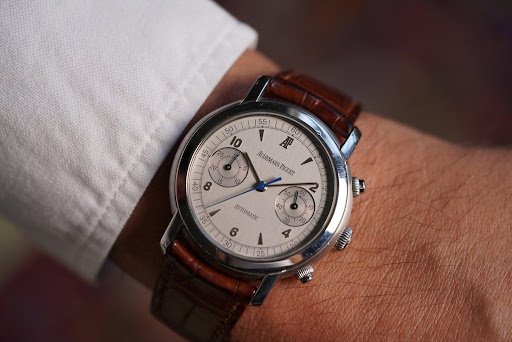
The Audemars Piguet Jules Audemars collection is best known for its classical round cases, traditional Haute Horlogerie design and unusually sophisticated mechanical complications. Unlike the angular, sporty Royal Oak, Jules Audemars watches were created around a more traditional dress-watch aesthetic, often combining precious-metal cases with leather straps and highly finished mechanical movements.
The collection was named after Jules Louis Audemars, one of Audemars Piguet’s founders, and became a showcase for some of the manufacture’s most technically ambitious work. Depending on the reference, special features can include perpetual calendars, minute repeaters, tourbillons, split-seconds chronographs, Equation of Time displays, astronomical moon phases and even Audemars Piguet’s experimental high-performance escapement.
Audemars Piguet Jules Audemars Features at a Glance
| Feature | What Makes It Special |
| Case design | Traditional round case rather than Royal Oak’s octagonal form |
| Materials | Frequently produced in precious metals such as gold and platinum |
| Style | Classical, elegant and generally more discreet than Royal Oak models |
| Complications | Perpetual calendars, tourbillons, minute repeaters, Equation of Time and Grande Complications |
| Movements | High-end mechanical calibres with extensive hand finishing |
| Dial design | Ranges from minimalist dress-watch layouts to highly complicated astronomical displays |
| Straps | Commonly paired with leather rather than an integrated metal bracelet |
| Historical connection | Named after AP co-founder Jules Louis Audemars |
| Production status | A discontinued collection, now primarily found on the secondary and collector market |
A Classical Side of Audemars Piguet
For many people, Audemars Piguet immediately means the Royal Oak. Jules Audemars represents a very different side of the manufacture.
The collection was introduced in the 1990s and named after Jules Louis Audemars, who co-founded the company with Edward Auguste Piguet. Instead of following the sporty architecture of the Royal Oak, the line returned to traditional watchmaking proportions and round cases. Phillips describes it as a deliberate move toward timeless, classically styled complicated watches.
That distinction is important.
A Jules Audemars can contain extremely sophisticated mechanics without looking like a sports watch. From the outside, some references are remarkably restrained. The technical complexity is often revealed only when you examine the dial or turn the watch over.
For collectors who appreciate traditional Audemars Piguet design, the Jules Audemars collection offers a refined alternative to the more recognizable Royal Oak. If you are looking for a classic AP with elegant proportions, precious-metal cases and high-level mechanical watchmaking, you can Buy AP Jules models by comparing the exact reference, movement, condition and complication that best match your collection.
1. Traditional Round Case Design
One of the easiest ways to recognize a Jules Audemars is its shape.
Instead of the Royal Oak’s:
- Octagonal bezel
- Exposed screws
- Integrated bracelet
- Strong geometric surfaces
the Jules Audemars typically uses a traditional round case with elegant lugs and a leather strap.
This gives the collection a more formal appearance and places the focus on the movement, dial and complications rather than an instantly recognizable case design.
Case sizes vary considerably between references. Some are restrained dress watches, while complicated models can be substantially larger to accommodate their movements.
The result is a collection that can look much more conventional from a distance while becoming significantly more interesting under close inspection.
2. Precious-Metal Cases
Precious metals are another defining characteristic of many Jules Audemars watches.
References can be found in:
- Yellow gold
- Pink gold
- White gold
- Platinum
This differs from the steel sports-watch identity strongly associated with many Royal Oak references.
For example, the Jules Audemars Equation of Time was offered in precious-metal cases, while the particularly technical Jules Audemars Chronometer with AP Escapement appeared in platinum and pink-gold versions.
The precious-metal construction reinforces the collection’s traditional Haute Horlogerie character.
3. Exceptional Mechanical Complications
The most important special feature of the Jules Audemars family is not one visual characteristic.
It is mechanical complexity.
The collection became a platform for complications that demonstrate Audemars Piguet’s traditional watchmaking expertise.
Different Jules Audemars references have included:
- Perpetual calendars
- Minute repeaters
- Tourbillons
- Split-seconds chronographs
- Moon-phase displays
- Equation of Time
- Sunrise and sunset indicators
- Grande Complications
Not every Jules Audemars is complicated. Simpler and extra-thin models also exist. However, the most significant references are closely linked with Audemars Piguet’s complicated-watchmaking heritage.
4. Jules Audemars Grande Complication
One of the strongest examples is the Jules Audemars Grande Complication.
Audemars Piguet states that its first Grande Complication wristwatch appeared in 1996 inside a Jules Audemars case only 8.5 mm thick. A Royal Oak Grande Complication followed the next year.
For Audemars Piguet, a Grande Complication combines three major complications:
- Minute repeater
- Split-seconds chronograph
- Perpetual calendar
Combining all three in a mechanical wristwatch requires an extraordinary number of interconnected components and significant expertise in assembly, regulation and finishing.
This history makes Jules Audemars much more than simply an alternative AP dress-watch line. It played an important role in housing some of the manufacture’s most difficult movements.
5. Equation of Time
Among the most unusual Jules Audemars watches is the Equation of Time.
A normal watch displays mean civil time. Actual solar time varies slightly because of the Earth’s elliptical orbit and the angle of its rotational axis.
An Equation of Time complication displays that difference mechanically.
But the Jules Audemars version went much further.
Its functions could include:
- Hours and minutes
- Perpetual calendar
- Leap-year indication
- Astronomical moon phase
- Equation of Time
- Sunrise time
- Sunset time
Even more unusually, the astronomical displays could be configured according to a geographical location selected for the owner.
That makes it one of the collection’s most technically distinctive models.
6. Location-Specific Sunrise and Sunset Display
The sunrise and sunset indications deserve special attention.
Sunrise and sunset do not occur at the same time everywhere. Their timing depends on geographical location and changes throughout the year.
Audemars Piguet therefore engineered the Jules Audemars Equation of Time around the owner’s chosen location.
Specially calculated cams control the sunrise and sunset indications, while the reference location is identified on the watch.
The system also makes it possible to display solar culmination—the point at which the sun reaches its highest position in the sky for that location.
This is not a complication added merely for visual effect. It requires the movement to mechanically reproduce astronomical information specific to a particular place on Earth.
7. High-Precision Astronomical Moon Phase
Certain Jules Audemars Equation of Time models also contain a significantly more accurate moon-phase mechanism than an ordinary moon-phase watch.
The skeleton Equation of Time submitted to the Grand Prix d’Horlogerie de Genève used a sophisticated astronomical moon display designed to remain accurate over an exceptionally long period before requiring correction.
This is a useful example of the philosophy behind the collection.
A standard complication was often not enough. Audemars Piguet used Jules Audemars references to explore technically more ambitious versions of familiar watchmaking functions.
8. The AP Escapement
Another highly distinctive watch is the Jules Audemars Chronometer with AP Escapement.
Rather than hiding the mechanism underneath a conventional dial, Audemars Piguet exposed much of the calibre so its architecture becomes part of the watch’s appearance.
The hand-wound Calibre 2908 consists of 267 components and uses Audemars Piguet’s proprietary escapement architecture. The movement was presented as part of the manufacture’s pursuit of increased precision and efficiency.
The open construction allows you to see elements including the escapement, barrels and regulating system from the dial side.
It is a very different visual experience from a simple Jules Audemars dress watch, but it maintains the same traditional round-case foundation.
9. Extra-Thin Watchmaking
Complexity was not the collection’s only goal.
Jules Audemars also included Extra-Thin models, demonstrating the opposite watchmaking challenge: reducing thickness while maintaining elegant mechanical construction.
The Fondation Haute Horlogerie notes that a Jules Audemars Extra-Thin joined the collection in 2010 and drew inspiration from an earlier AP model associated with the famous ultra-thin Calibre 2120.
This side of Jules Audemars is particularly important because it demonstrates that the collection should not be viewed exclusively as a family of complicated watches.
At one end were highly complex astronomical and chiming watches.
At the other were restrained, thin dress watches.
Both reflected traditional fine watchmaking.
10. Movement Finishing
A complicated movement is not automatically Haute Horlogerie simply because it contains many parts.
Finishing matters too.
Jules Audemars movements frequently place considerable emphasis on traditional decorative techniques and carefully finished components. Depending on the reference, a sapphire caseback or openworked construction allows much of this work to remain visible.
On particularly elaborate versions, the finishing itself becomes part of the attraction rather than something hidden inside the case.
The Jules Audemars Chronometer with AP Escapement is an extreme example: the movement’s architecture is intentionally exposed, with its mainplate and mechanical components forming much of the dial-side visual design.
11. Openworked and Skeleton Models
Audemars Piguet also produced openworked Jules Audemars watches.
Skeletonisation is especially appropriate for a collection centered on mechanical craftsmanship because it removes unnecessary material from the movement to expose the underlying construction.
This requires more than simply making the movement visible.
The components still need sufficient structural integrity while being shaped and finished so they become aesthetically pleasing from multiple angles.
One of the most ambitious examples is the Jules Audemars Equation of Time Skeleton, which combined an openworked movement with an Equation of Time, perpetual calendar and astronomical indications.
12. A More Discreet Alternative to the Royal Oak
One of the Jules Audemars collection’s most appealing characteristics today is that it does not immediately resemble the AP most people know.
Royal Oak designs are instantly recognizable.
Jules Audemars is more discreet.
A simple reference can appear to be a traditional Swiss dress watch until its dial, movement and finishing are examined more carefully.
That can make the collection attractive to enthusiasts who appreciate Audemars Piguet’s watchmaking but do not necessarily want:
- An octagonal sports watch
- An integrated bracelet
- A highly recognizable design
- The visual presence of a Royal Oak or Offshore
Jules Audemars offers a more traditional interpretation of AP.
Jules Audemars vs Royal Oak
Although both were made by Audemars Piguet, they serve very different purposes.
| Jules Audemars | Royal Oak |
| Traditional round case | Octagonal case and bezel |
| Mainly classical aesthetic | Luxury sports-watch aesthetic |
| Leather straps common | Integrated bracelet central to the design |
| Often precious metal | Steel historically central to the collection |
| Focus on traditional complications | Combines complications with iconic sports design |
| More discreet recognition | Immediately recognizable |
| Dress-watch character | Sport-luxury character |
The Royal Oak is the more recognizable design.
The Jules Audemars arguably provides a clearer look at the traditional complicated watchmaking that defined Audemars Piguet long before the Royal Oak appeared in 1972.
Is the Jules Audemars Collection Still Produced?
The Jules Audemars collection is discontinued, so these watches are now primarily encountered through pre-owned dealers, specialist collectors and auctions. Recent Phillips cataloguing also identifies Jules Audemars as a discontinued collection.
That makes reference-level research particularly important.
There is no single specification that applies to every Jules Audemars watch. Case size, movement, material, complication and production numbers can differ significantly.
Before purchasing one, check:
- Exact reference number
- Case material
- Movement calibre
- Service history
- Original dial and movement condition
- Box and documentation
- Correct strap and buckle
- Complication functionality
- Availability of specialist servicing
This becomes especially important with complicated models, where servicing requirements can be considerably more demanding than with a simple time-only mechanical watch.
What Makes Jules Audemars Special for Collectors?
Jules Audemars occupies an interesting position in Audemars Piguet history.
It does not have the universal recognition of the Royal Oak, but that is part of its appeal.
The collection gives collectors access to a period in which AP placed extraordinary mechanical ideas inside relatively traditional cases. A single family included understated extra-thin watches alongside tourbillons, repeaters, astronomical complications and Grande Complications.
Its strongest collector appeal comes from the combination of:
Traditional design + low-key AP identity + serious mechanical watchmaking.
- For a collector interested primarily in brand recognition, a Royal Oak may make more sense.
- For someone interested in Audemars Piguet’s traditional watchmaking expertise, Jules Audemars can be considerably more fascinating.
Final Takeaway
The special features of Audemars Piguet Jules Audemars watches depend on the reference, but the collection is defined by classical round cases, precious materials, traditional Haute Horlogerie finishing and an extraordinary range of mechanical complications.
Its most impressive models demonstrate functions such as perpetual calendars, minute repeaters, split-seconds chronographs, tourbillons, Equation of Time, location-specific sunrise and sunset indications and high-precision astronomical moon phases. The collection also housed Audemars Piguet’s first Grande Complication wristwatch in 1996.
In short, the Royal Oak represents the revolutionary design side of Audemars Piguet, while Jules Audemars represents much of the brand’s classical mechanical side.
That difference is what makes discontinued Jules Audemars watches particularly interesting today.
Frequently Asked Questions
1.What is an Audemars Piguet Jules Audemars watch?
Jules Audemars is a discontinued Audemars Piguet collection named after co-founder Jules Louis Audemars. It is characterized primarily by traditional round cases, classical styling and mechanical movements ranging from simple extra-thin calibres to major complications.
2.What are the most special Jules Audemars complications?
Depending on the reference, the collection has featured perpetual calendars, minute repeaters, tourbillons, split-seconds chronographs, Equation of Time displays, sunrise and sunset indicators, astronomical moon phases and Grande Complications.
3.Is Jules Audemars the same as Royal Oak?
No. Both are Audemars Piguet collections, but their designs are fundamentally different. Jules Audemars generally uses a traditional round case and leather strap, while the Royal Oak is defined by its octagonal bezel and integrated-bracelet architecture.
4.Why is the Jules Audemars Equation of Time special?
It combines advanced astronomical indications with a perpetual calendar. Certain versions display Equation of Time as well as sunrise and sunset times calibrated for a chosen geographical location, making it one of the collection’s most technically distinctive watches.
5.Is Audemars Piguet Jules Audemars discontinued?
Yes. The Jules Audemars line is a discontinued collection, meaning buyers looking for one today generally need to search the pre-owned or auction market.
6.Is a Jules Audemars worth collecting?
It can be particularly interesting for collectors who value traditional Audemars Piguet watchmaking rather than focusing only on Royal Oak models. Desirability varies significantly by reference, complication, condition, rarity, originality and provenance, so individual watches should be evaluated separately.