Sellers are not always dishonest. Most private sellers genuinely believe what they are telling you about their car. They think the mileage is about right. They do not know about the outstanding finance from the previous owner. They have forgotten the advisory from the last MOT or assumed someone else dealt with it.
The point of a car check is not to catch liars. It is to fill in the gaps that exist even in perfectly honest conversations about a vehicle’s history. The seller can only tell you what they know. The records know more.
A free car check gives you access to those records before you view, before you test drive, and before you form any attachment to the car. Here are five specific things it surfaces that almost never come up in a conversation with a seller.
1. The real mileage story, not just the current odometer reading
A seller tells you the car has done 62,000 miles. You look at the odometer and it shows 62,000 miles. That appears to confirm the claim.
What it actually confirms is that the odometer currently reads 62,000 miles. That is not the same thing.
Every MOT test in the UK since 2005 records the mileage at the time of testing. A free car check surfaces all of those recorded figures in a single timeline. If the mileage has risen consistently year on year, the current reading makes sense. If it jumped by 30,000 miles between one test and the next, or barely moved across several years, there is a question to answer.
This is how mileage discrepancies get caught. Not from looking at the dial, but from comparing what the dial says now against what it said at every test the car has been through. A seller usually cannot explain an inconsistency they did not create, but at least you know to ask before any money changes hands.
2. Whether the car is actually road legal right now
It sounds basic, but a surprising number of used cars are advertised with expired MOTs or lapsed road tax. Sometimes the seller knows and has not mentioned it. Sometimes they have genuinely lost track.
A free car check shows you the current tax status and the MOT expiry date instantly. If the tax has lapsed, you cannot legally drive the car on public roads after purchase without renewing it immediately. If the MOT has expired, you cannot drive it at all except to a pre booked MOT appointment.
Neither of these is a dealbreaker in itself. But both are bargaining points. A car that needs an immediate MOT to be driveable is not worth the same as one with twelve months of certificate remaining. Knowing before you view means you negotiate from the right starting point.
3. How many times the car has changed hands and how recently
The number of previous keepers matters. Not because high keeper counts are automatically a problem, but because the pattern of ownership tells you something about why the car moved between owners and how it was likely used.
A car with one or two keepers across eight years suggests consistent ownership and probably consistent maintenance. A car that has passed through five owners in three years raises natural questions. Was there a recurring fault? Was it traded down through dealers trying to shift a problem? Did each successive owner give up on it?
The V5C issue date matters too. A logbook issued very recently on an older car can mean a legitimate transfer, or it can suggest the documentation history has been disrupted. Combined with other information from the check, it helps you form a more complete picture of what you are actually looking at.
Sellers rarely volunteer this information unprompted. Most do not think it is relevant. The check makes it available without you having to ask.
4. What the MOT history actually says about the car’s condition
Sellers almost always mention the MOT. ‘Just had a new MOT’ is one of the most common phrases in used car listings. What they rarely mention is what the MOT history behind that certificate looks like.
A free car check gives you the full test record going back years. Passes, failures, advisory notices, and the mileage at each test. That history is considerably more informative than the current certificate alone.
What to look for:
- Repeat advisories. The same advisory appearing at consecutive tests tells you the owner was aware of an issue and chose not to address it. That issue is now your concern.
- Previous failures. A car that has repeatedly failed for the same reason has a pattern worth understanding before you buy.
- Structural advisories. Corrosion noted on the chassis, sills, or floor is significant regardless of when it was noted. Rust does not resolve itself.
- Emissions failures on diesel cars. Repeated DPF or emissions related failures on a diesel can indicate an ongoing issue that has been temporarily resolved rather than properly fixed.
- The gap since the last test. A car that has not been tested for an unusual length of time has a story behind that gap worth understanding.
None of this requires mechanical expertise to interpret. A consistent record with minor advisories is reassuring. A record full of repeated failures and unaddressed notices is not. The check puts that information in front of you before you drive to view the car.
5. Whether the spec matches what is being advertised
Used car listings are written by people, not pulled directly from official databases. Sellers describe their car from memory, from the original advert they bought from, or from what they think is true. That means the engine size, fuel type, colour, and trim level in a listing do not always match what the DVLA has on record for that registration number.
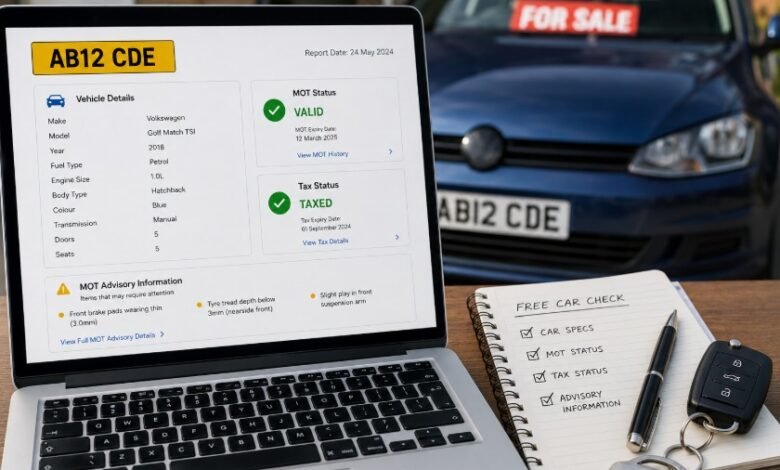
A free car check surfaces the official DVLA registered details for the vehicle. Make, model, fuel type, engine size, colour on record, Euro emission standard, and performance specifications. Cross referencing those against the listing takes thirty seconds and can flag discrepancies before you have made any effort to view the car.
A colour mismatch is not always sinister. The car may have been resprayed and the record not updated, which is itself worth knowing. But a fuel type discrepancy, an engine size difference, or a model variant that does not match what is advertised can affect insurance premiums, ULEZ compliance, and resale value in ways that matter.
Free, official, instant. There is no good reason not to check.
Is a free car check enough before buying a used car
For some purposes, yes. For the full picture, no.
The free check is the right first move on any car you are considering. It filters out obvious problems, surfaces the mileage history, confirms the spec, and tells you whether the car is road legal. All of that before you have spent anything or committed to anything.
What it does not cover is the layer of checks that require access to private databases. Outstanding finance sits in finance company records, not DVLA records. Stolen vehicle data sits in the Police National Computer. Insurance write off records are held by insurers. None of those appear in a free check.
The practical approach most experienced buyers use: run the free check on every car you are interested in. Use it to decide whether the car is worth investigating further. If it passes that filter and you are genuinely considering a purchase, run a full history report before you commit to anything. The full report starts at £4.99 for a five check bundle, which works out cheaper per check than most people spend on coffee in a week.
How to do a free car check in the UK
The process takes under two minutes from start to finish.
- Find the registration number. It will be in the listing, on the plate, or on any documents the seller has shared.
- Go to the check tool. No account needed, no payment details, nothing to sign up for.
- Enter the registration and run the check. The report returns instantly.
- Read through the results. MOT history, mileage trail, tax status, keeper count, DVLA spec. Check that the details match the listing and that the mileage figures make sense.
- Decide whether to go further. If the free check raises concerns, you have saved yourself a wasted viewing. If it looks clean and you are interested, upgrade to a full report before you hand over any money.
You can get a free car check on CarAnalytics in seconds using just the registration plate. No subscription, no hidden fees, and no account required. It is the fastest way to know whether a car is worth your time before you invest any of it.
What you need to run a car check
Just the registration number. That is it.
The registration number connects to every official record held against that vehicle. You do not need the VIN, the V5C document, or any other paperwork to run a check. The plate alone is enough to surface the MOT history, tax status, mileage records, and DVLA registered details.
If you are responding to a listing and the seller has not included the registration number, it is entirely reasonable to ask for it before arranging a viewing. A seller who is reluctant to share a registration number is, in itself, something worth noting.
When in the buying process should you run the check
Before you contact the seller.
That is the most useful moment. You have seen the listing, you have the registration number, and you have not yet invested time, travel, or expectation into the car. The check takes ninety seconds. If it surfaces something concerning, you have lost nothing. If it comes back clean, you contact the seller with more confidence and more specific questions.
Running the check after a test drive, or worse after agreeing a price verbally, puts you in a much weaker position. The attachment has formed. The seller is expecting a decision. The check should come before any of that, not as an afterthought.
Free car check vs paid car check: what is the actual difference
The free check and the paid check draw from different data sources and serve different purposes. Understanding the difference helps you use both correctly.
- Free check sources: DVLA and DVSA. Official government records covering registration data, MOT history, tax status, mileage at test, vehicle spec, and keeper count.
- Paid check sources: Finance databases, Police National Computer, Motor Insurance Anti Fraud and Theft Register, insurance write off databases, and salvage records. These are private databases that require commercial agreements to access.
The free check tells you about the car’s registered life. The paid check tells you about the car’s risk profile. Both are useful. Neither replaces the other.
For a car you are seriously considering buying, running both is the complete approach. Start free, upgrade when you are ready to commit. A car history check using CarAnalytics covers all of it in one place, with the option to start free and upgrade only when you need the full picture.
The habit that protects every used car purchase
There is a version of used car buying that goes well almost every time. It is not complicated and it does not require expertise. It just requires doing the check before anything else.
Experienced buyers do not skip the check because the car looks good in photos. They do not skip it because the seller seems trustworthy. They do not skip it because they have bought plenty of used cars before. They check every single time, because the check is the only way to know what the records say, and the records know things the seller cannot tell you.
The free check takes ninety seconds. It costs nothing. It has the potential to save you considerably more than nothing. There is no rational argument for skipping it.