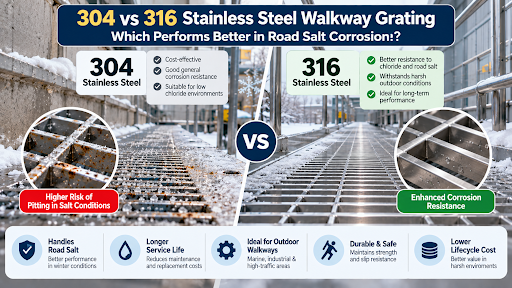
A walkway takes a beating in winter. Salt gets spread, slush piles up, meltwater sits around, and then it all freezes and thaws again. Chloride deposits can hang on to the grating through every bit of it. So, if you’re picking stainless steel walkways for an industrial, commercial or processing facility, 304 vs 316 matters. Both resist corrosion. Chlorides just hit them differently.
Why Road Salt Is a Concern for Stainless Steel
Stainless steel possesses a thin passive layer on its surface, and it forms all on its own. The layer helps metal resists corrosion. Chloride ions can locally destabilize the passive film under aggressive conditions, increasing the risk of pitting and crevice corrosion. Although stainless steel can repassivate, corrosion may continue if the environment remains aggressive.
Road de-icing products commonly contain chloride salts, including sodium chloride, calcium chloride or magnesium chloride. These salts can increase the risk of localized corrosion when moisture and chloride deposits remain on stainless steel. Boots carry it in. So do vehicles and equipment. Wind blows it around, and melting snow moves it onto outdoor walkways. It does the most harm wherever salty water gets stuck: corners, under deposits, around fasteners, anywhere that’s slow to dry.
So, does the steel just rust when salt lands on it? No. That’s too simple. Grade, salt concentration, temperature, moisture, drainage, surface condition and upkeep all play a part.
304 Stainless Steel: Where It Fits
You see 304 all over the place, and for good reason. General corrosion resistance is strong, and it costs less than 316. It works indoors. It works in many general industrial settings too, as long as moisture is moderate and chlorides are low.
Say a walkway is mostly covered, drains well and barely sees road salt. 304 is a practical pick there. It’s common around food production and general manufacturing where conditions aren’t harsh, and the same goes for food processing equipment when chloride exposure is under control.
304 is a solid standard grade. People get into trouble when they put it somewhere harsher than its specification allows.
316 Stainless Steel: Why It Handles Salt Better
The difference is molybdenum. 316 has it, and it helps the steel resist chloride-related pitting and crevice corrosion. However, 316 makes more sense when stainless faces salt, saline conditions, aggressive cleaning chemicals or other chloride-rich exposure repeatedly.
For outdoor grating exposed to winter road salt, 316 gives you a wider corrosion-resistance margin than 304. Consider 316 when the walkway experiences frequent road-salt exposure, persistent moisture, or chloride deposits that are difficult to remove. High-traffic areas may also warrant closer evaluation if they bring additional salt and contaminants onto the surface.
Still, don’t assume 316 can’t corrode. It can. Heavy chloride concentrations, stagnant moisture, deposits and unsuitable cleaning chemicals can all still cause problems. You have to look at the complete service environment.
304 vs 316 for Winter Walkways
Picture the walkway in real use and it gets easier.
A covered indoor access platform with little salt? 304 may do fine. An outdoor walkway beside a route that’s salted often is a different case. It gets deposit after deposit. Repeated wet-dry cycles can concentrate chloride deposits as water evaporates, particularly when the surface is not rinsed adequately.
For that, 316 is usually the more corrosion-resistant choice. Canadian stainless steel suppliers and fabricators commonly point to 316 for salt-exposed, marine, wet or chemically aggressive applications, while 304 stays suitable for many general-use environments.
Then there’s the money side. 316 usually costs more than 304 because of its alloy composition. Weigh that higher upfront price against service life, cleaning, how hard replacement would be, and downtime.
What About Food Processing Areas?
Salt isn’t only outdoors. Some facilities work with brine, ingredients that contain salt, or aggressive sanitation chemicals. So even inside a building, grade selection can matter.
Around food processing equipment and the access structures next to it, 304 may be enough where exposure is mild. Brine, chloride-rich cleaning solutions and frequent washdown can increase corrosion risk, particularly when moisture remains trapped in joints or crevices. Depending on the chemical concentration, temperature and cleaning procedure, 316 or 316L may offer improved corrosion resistance. The final grade should be selected based on the actual operating and sanitation conditions.
Hygiene depends on fabrication and finish too. Smooth surfaces, suitable welds, drainage, and cleanable joints; all of it leaves fewer places for moisture and residue to get trapped. Think of grade, design, finish and cleaning requirements as one package.
Grating Design Matters as Much as Grade
A 316 grating won’t rescue a poor walkway design. Water has to drain off, not sit around supports, joints and edges.
Surface profile matters as well. Serrated grating can improve slip resistance when it’s wet. Spacing should suit the intended use and safety requirements, and load capacity, span, bearing bar size and supports all need to be specified correctly.
Then there’s fabrication quality. Cutting, welding, grinding, finishing and cleaning can each change how well the metal resists corrosion. Contamination from carbon steel or unsuitable handling can cause surface problems, even on a base material that resists corrosion.
Got a custom project? Experienced metal fabrication Toronto specialists can help you match material grade, grating style, dimensions, load requirements and finish to the working environment. The aim is a system that fits the actual conditions.
Maintenance Can Extend Grating Life
Even 316 gains from sensible maintenance. Try not to let salt deposits build up. Rinse or clean the grating regularly, and you take off chloride residue before it concentrates.
Check the drainage too. If water keeps pooling below the grating or around supports, the surrounding structure may be the cause, not the stainless steel.
However, look for staining, pits, residue, damaged surfaces and trapped moisture. Fixing things early beats replacing a load-bearing walkway after corrosion has progressed.
Cleaning chemicals should be compatible with the stainless grade and finish. Use cleaning products approved for the stainless steel grade and finish. Avoid unsuitable bleach or hypochlorite-based cleaners, and follow the manufacturer’s guidance on concentration, contact time and rinsing.
When Should You Choose 304 or 316?
Begin with the environment. Price can wait.
Choose 304 when:
- Salt exposure is limited or occasional.
- The walkway is mostly indoors or protected.
- Drainage is good and moisture doesn’t stay trapped.
- Cleaning chemicals are mild.
- You want good corrosion resistance without the added cost of 316.
Consider 316 when:
- Road salt reaches the walkway on a regular basis.
- The surface stays wet or gets repeated washdown.
- Brine or chloride-containing chemicals are present.
- The walkway is exposed to outdoor winter conditions.
- Replacing corroded grating would be difficult or disruptive.
Still unsure? Ask an engineer or a qualified fabricator to look at chloride exposure, cleaning, temperature, drainage and service conditions before you order.
Making the Right Specification
316 isn’t always necessary. If the environment is controlled and low in chlorides, 304 can perform reliably and might cost less. Outdoors, where salting is regular, 316 can justify the higher upfront price.
Don’t just ask for “stainless steel.” Give the exact grade, finish, grating type, load capacity and fabrication requirements. That way the fabricator has enough information to produce a suitable walkway.
Looking at stainless steel walkways? Think beyond the first purchase price. How much salt will the surface see? How easy is it to clean? How does water drain? How hard would replacement be? When winter salt keeps causing trouble, choosing the appropriate grade at the design stage can help reduce corrosion risk and maintenance problems.
Final Thoughts
Road salt is a serious chloride exposure, but the right material choice can change the outcome a lot. 304 is still useful for many general applications. 316 gives greater resistance where salt and chlorides are a regular part of the environment.
Your project might also include custom platforms, stairs, guards or metal fabrication Toronto. If so, talk through the operating environment with the fabricator. A proper specification looks at stainless grade, grating design, finish, drainage, load requirements and maintenance routine together.