Why Is the Surface Chemistry of a Needle Tip the Variable That Determines Whether a Patient Says “That Was Nothing” or Braces for Impact?

Most people, if asked to describe what determines whether a needle injection is painful, would point to the needle gauge — the diameter of the bore — or perhaps the speed of injection, or the skill of the clinician administering it. These are real variables. A finer gauge needle distributes penetration force over less tissue contact area. A skilled clinician moves with confidence and consistency. These things matter.
What almost no patient considers, and what many clinicians have never stopped to examine explicitly, is that the dominant variable in how a needle feels entering tissue has nothing to do with its diameter and almost everything to do with the chemistry of its outermost surface. Specifically: whether that surface is coated with a material that reduces friction, what that coating is made of, how uniformly it is applied, and whether it remains intact across the full arc of the penetration event.
What happens mechanically when a needle enters tissue.
The force required to penetrate skin and subcutaneous tissue with a needle has been measured extensively in biomechanics and device testing literature. The penetration force curve for a standard hypodermic needle has a characteristic shape: a sharp initial peak as the needle tip breaches the skin surface, followed by a lower-force plateau as the needle advances through subcutaneous tissue, and sometimes a secondary peak if the needle encounters fascia or denser tissue layers.
The initial peak — the puncture force — is the primary determinant of pain perception. It is the moment of maximum tissue deformation before the skin yields to the needle tip, and it is the moment the patient registers as the “stick.” The magnitude of this peak is directly influenced by two needle properties: the sharpness of the tip geometry and the friction coefficient of the needle surface.
A needle tip with a low friction surface penetrates tissue with less resistance at initial contact than an identical tip without a coating. The difference is measurable and clinically significant. Comparative studies of coated versus uncoated needles of the same gauge and tip geometry consistently show that surface coating reduces peak penetration force — and the subjective pain reported by patients correlates with peak penetration force, not with the total force integrated across the insertion event.
Why coating chemistry matters more than coating presence.
The simple observation that coating reduces friction understates the complexity of what an optimal coating must achieve on a needle tip. A coating applied to the shaft of the needle must extend uniformly to the tip geometry — the most critical region for penetration force reduction — without altering the dimensional precision of the tip or adding thickness that would effectively increase the needle gauge at the point of initial contact.
This is a materials application challenge that is significantly more demanding than coating a flat surface or a smooth cylinder. Needle tips are three-dimensional geometries machined to tolerances measured in microns. A coating that is too thick at the tip changes its effective diameter and can alter the sharpness geometry that was engineered into the needle’s design. A coating that fails to adhere uniformly at the tip — either because of the geometry’s surface energy characteristics or because of the application process — leaves the highest-stress contact region unprotected and largely defeats the purpose of coating the device.
The coating chemistry must therefore achieve two things simultaneously: excellent adhesion to the substrate across complex geometry, and sufficiently low thickness that the tip’s designed dimensions and sharpness characteristics are preserved. These requirements pull in opposite directions — the molecular structures that provide the best low-friction surface properties are often hydrophobic materials that have poor intrinsic adhesion to metal substrates without primer chemistry, and the thinnest coatings are the most demanding to apply uniformly across complex geometry.
Why PFAS elimination has forced coating chemistry innovation.
For decades, the dominant low-friction coating approach for medical needles and cutting instruments was based on PTFE and related fluoropolymer chemistries — the broad category of per- and polyfluoroalkyl substances now grouped under the regulatory category of PFAS. These coatings achieved genuinely excellent lubricity, thin-film deposition, and the thermal stability required for medical device sterilization processes. They became the industry default precisely because they worked.
The accelerating regulatory pressure on PFAS — driven by growing evidence of environmental persistence and bioaccumulation, and reflected in tightening regulations in the EU, U.S., and multiple other jurisdictions — has forced medical device manufacturers to evaluate whether PFAS-containing coatings remain viable in their long-term supply chains. For devices that are intended for single use, implantable, or used in contact with vulnerable tissue, the regulatory trajectory makes continued PFAS reliance a strategic risk, independent of any current requirement to change.
The material science challenge this creates is non-trivial: finding chemistry that matches PTFE’s lubricity in thin-film application on metal substrates, maintains adhesion through sterilization cycles, and eliminates PFAS content — while meeting the biocompatibility requirements of medical device regulatory frameworks. This is not a question of simply substituting one chemical for another. It is a reformulation problem that requires understanding the molecular mechanisms by which friction reduction occurs and identifying alternative chemistry that reproduces those mechanisms without the fluorocarbon backbone that PFAS concerns.
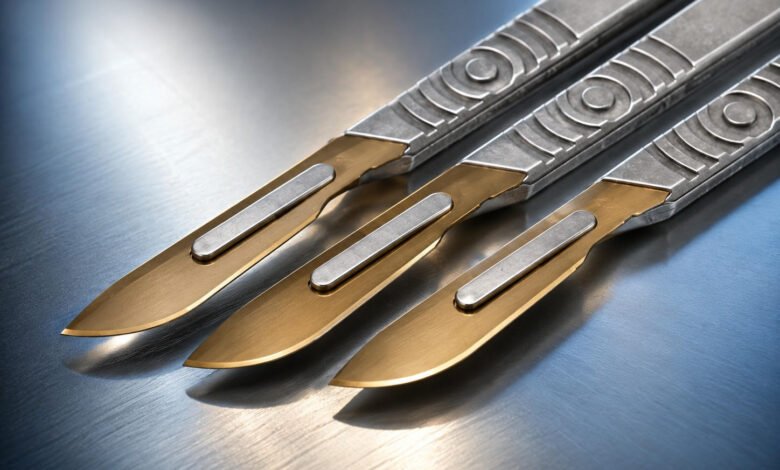
MediSlick N3 coating represents exactly this kind of reformulation: a micron-thin, PFAS-free coating developed specifically for needles and cutting edges such as scalpels and blades, designed to provide low-friction surface performance in applications where penetration force reduction and cutting performance are critical clinical requirements — without the regulatory exposure associated with PFAS-containing coating chemistries.
Why the patient experience connects to regulatory chemistry in ways no one explains.
The connection between materials science, regulatory change, and the subjective experience of a patient receiving an injection is not one that most healthcare conversations make explicit. The patient who says “that was nothing” after a blood draw, or who describes a vaccination as barely registering, is benefiting from decades of surface chemistry development applied to the last few millimeters of a device they never see.
The current moment in medical device coating represents a transition that patients will experience but never consciously observe: coatings reformulated to eliminate PFAS content, tested to confirm that the reduction in penetration force achieved by PTFE-based predecessors is preserved, and validated through biocompatibility testing to confirm that the new chemistry is at least as safe as the standard it replaces.
The needle that enters tissue smoothly, that produces the lowest possible penetration force, that feels like nothing — that outcome is the accumulated result of chemistry, geometry, application precision, and regulatory navigation that the patient holding out their arm has no reason to know anything about. It is engineering in service of experience, invisible by design and measurable only in what it prevents.