Why React Native App Development Is Becoming a Practical Choice for UK Businesses

Mobile apps have become an important part of how modern businesses connect with customers. From online shopping and banking to booking services and business management, people increasingly expect convenient digital experiences on their phones. For UK businesses, this creates an opportunity to use mobile technology without necessarily maintaining completely separate development teams for every platform.
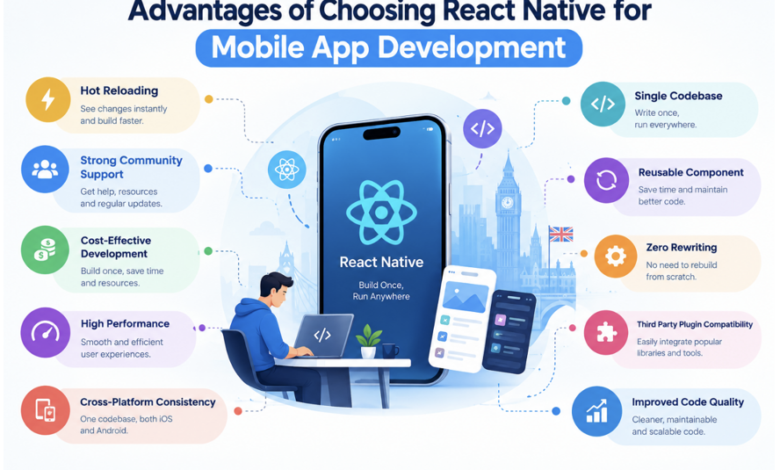
This is one reason react native app development is becoming a practical option for companies that want to build applications for both iOS and Android. React Native allows developers to share a significant amount of code across platforms while still creating apps that interact with native device capabilities.
For growing businesses, this can make mobile development easier to manage, particularly when speed, scalability, and development resources matter.
Table of Contents
1. What Is React Native?
React Native is an open-source framework developed by Meta for building mobile applications using React and JavaScript or TypeScript.
Its main attraction is the ability to share code between iOS and Android applications. However, it does not simply create a website inside a mobile container.
React Native uses native platform components and also allows developers to introduce platform-specific code when required. The official documentation explains that developers can create platform-specific implementations for iOS and Android when certain features or behaviours need to differ.
This balance between shared development and platform-specific functionality makes the framework useful for many business applications.
2. Why UK Businesses Are Considering React Native
UK businesses operate in a highly competitive digital environment.
Customers expect fast applications, simple navigation, secure transactions, and convenient access to services. At the same time, businesses need to control development costs and respond quickly when customer expectations change.
React Native can address several of these requirements.
A business may use it to develop:
The framework is not automatically suitable for every project. However, for many applications, its cross-platform approach can reduce unnecessary duplication.
3. One Development Approach for Multiple Platforms
One of React Native’s biggest attractions is code sharing.
Traditionally, a company developing an iPhone and Android application might maintain separate native development efforts. This can mean different codebases, development processes, testing requirements, and maintenance considerations.
React Native allows teams to share substantial parts of an application’s codebase.
That does not mean every line of code will be identical.
Some features require platform-specific implementation. React Native provides mechanisms such as the Platform module and platform-specific files for these situations.
For a growing company, this approach can simplify development while still allowing developers to tailor important experiences for each operating system.
4. Potential Cost and Time Advantages
Budget is a major consideration for businesses.
Developing two completely separate applications can require additional development resources. A shared-code approach can potentially reduce duplicated work.
However, businesses should avoid assuming that React Native automatically means an application will cost half as much.
Actual costs depend on:
The real advantage is often development efficiency rather than a guaranteed percentage saving.
If a team can reuse components, business logic, and other code across platforms, development resources can potentially be allocated more efficiently.
5. Better Opportunities for Faster Product Development
Speed matters when a business is testing a new digital idea.
Suppose a UK retailer wants to launch a customer loyalty application. Waiting for two completely independent applications could increase development complexity.
A cross-platform approach can provide a more coordinated development process.
Teams can work on shared functionality while testing the application across both operating systems.
This can be especially useful for startups and growing businesses that want to launch a minimum viable product before investing heavily in additional features.
The goal should not simply be to launch quickly.
The objective should be to launch a reliable product, gather customer feedback, and improve it based on real usage.
6. React Native and Native App Experience
One common misconception is that cross-platform applications necessarily feel like websites packaged as apps.
React Native takes a different approach.
The framework is click through rate designed to render interfaces using native platform components. Meta’s React Native principles emphasise providing experiences that match the expectations of individual platforms rather than forcing every platform into exactly the same interface.
Developers can also access native functionality when necessary.
For example, an application may need:
React Native can work with native modules and platform-specific code where required.
This provides flexibility without requiring every part of the application to be built separately.
7. Easier Maintenance and Future Updates
Building an application is only the beginning.
Once an app reaches customers, businesses need to maintain it. Operating systems change, security requirements evolve, devices become more advanced, and users expect new functionality.
A shared codebase can make certain maintenance tasks more straightforward.
Instead of implementing every business rule twice, developers may be able to update shared code and test the changes across both platforms.
React Native itself continues to evolve. Its official releases have introduced improvements to performance, tooling, architecture, and development workflows. For example, React Native 0.84 introduced Hermes V1 as the default JavaScript engine and continued the move away from the Legacy Architecture.
This ongoing development is important for businesses planning a product that may operate for several years.
8. A Growing Technology Ecosystem
Technology choices become more attractive when developers have access to established tools, libraries, documentation, and community support.
React Native has been used across a wide range of applications. Its official showcase includes products associated with companies such as Meta, Facebook, Instagram, and other established organisations. The React Native project states that thousands of applications use the framework.
The ecosystem is also expanding beyond traditional smartphone development.
In 2026, the React Native team announced official support for Meta Quest, demonstrating how the framework’s approach is extending to additional device categories.
For businesses, an established ecosystem can make it easier to find development resources and integrate commonly required technologies.
9. UK Mobile App Market Insights and Statistics
The UK’s mobile technology sector represents a significant part of the digital economy.
According to the Competition and Markets Authority’s 2024–25 annual report, almost 15,000 businesses are involved in developing apps used on mobile devices in the UK. The report estimates app development revenue at approximately £28 billion.
The broader UK business environment is also heavily digital.
The 2026 UK Business Data Survey reported that 86% of businesses handled some form of digitised data during 2025–26. That figure increased from 77% in the 2023–24 survey.
The UK also has a substantial business base. Government statistics recorded approximately 5.7 million private-sector businesses at the start of 2025, including more than 5.6 million small businesses.
These figures help explain why flexible digital development approaches are relevant to UK companies of different sizes.
Key Insight
The opportunity is not limited to large technology companies.
A small or medium-sized business can also use a mobile application to improve customer engagement, automate processes, create subscription services, or build a more convenient sales channel.
10. When React Native May Not Be the Right Choice
React Native is useful, but it is not a universal solution.
A company may need fully native development when its application depends heavily on specialised platform features, advanced graphics, highly customised operating-system behaviour, or extremely performance-sensitive functionality.
The best technology depends on the product.
Businesses should therefore avoid selecting React Native simply because it is popular.
Instead, development teams should evaluate:
A technical discovery phase can help determine whether React Native is appropriate before substantial development begins.
11. How UK Businesses Can Approach a React Native Project
A successful mobile application starts with a clear business objective.
Before hiring developers, define the problem your app should solve.
Then identify your essential features.
For example, an initial version might include:
Additional functionality can be introduced later.
Businesses should also select a development team with genuine React Native experience. Ask to see relevant applications, understand their testing process, and discuss how they handle native integrations.
Meta currently recommends using a React Native framework for new applications, with Expo identified in its guidance as the recommended community framework.
This is another reason businesses should assess not only developers but also the development approach they propose.
Frequently Asked Questions
Is React Native suitable for UK startups?
Yes, it can be suitable for startups that want to target iOS and Android without maintaining completely separate application codebases. Suitability depends on the product’s technical requirements.
Is React Native cheaper than native app development?
It can reduce duplicated development work, but there is no universal cost saving. The final price depends on features, design, integrations, testing, and maintenance.
Can React Native apps access phone hardware?
Yes. React Native applications can interact with many device capabilities through available APIs, libraries, and native modules.
Can React Native create both Android and iOS apps?
Yes. Cross-platform development for Android and iOS is one of its primary purposes.
Is React Native good for large businesses?
It can be. The technology is used in applications associated with major organisations, while its cross-platform model can also suit smaller companies.
Will React Native remain relevant?
The project continues to receive active releases and architectural improvements. Its expansion toward additional platforms also demonstrates continued development. However, businesses should always evaluate technology based on their specific long-term requirements.
Final Thoughts
React Native is becoming a practical consideration for UK businesses because it addresses several challenges associated with modern mobile development.
Its ability to share code across platforms, support native functionality, access a mature ecosystem, and evolve with new technologies can make it attractive to startups, SMEs, and larger organisations.
The most important point is that technology should serve the business rather than the other way around.
Before starting development, identify your users, define your objectives, establish your essential features, and evaluate the technical requirements carefully.
When those factors align with its strengths, React Native can provide a practical foundation for building and maintaining modern mobile applications across the UK market.