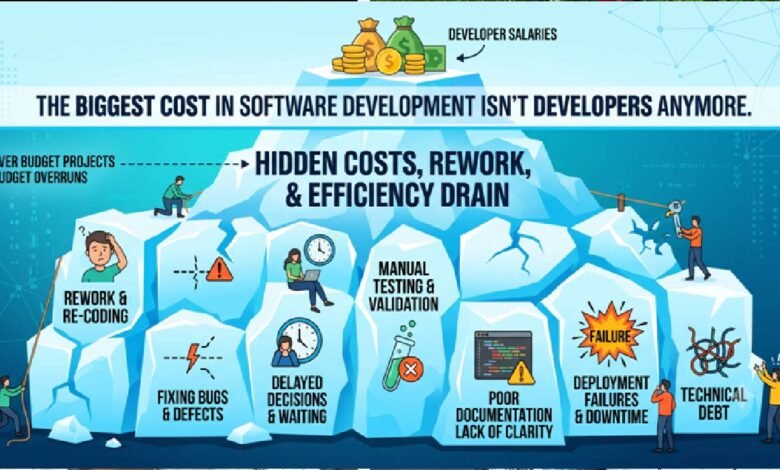
For years, businesses have treated developer salaries as the biggest expense in software projects. They negotiate hourly rates, compare outsourcing costs, and spend weeks looking for the “right” team.
Yet projects still run over budget.
The real cost rarely comes from writing code. In fact it comes from rework, delayed decisions, manual testing, poor documentation, deployment failures, and fixing problems that could have been caught much earlier.
Artificial intelligence is changing software development not just because it writes code, but because it reduces the expensive mistakes surrounding it.
The Cost Nobody Measures
Every software project accumulates hidden costs.
A feature gets rewritten because requirements changed. A bug reaches production because no one tested an edge case. Documentation becomes outdated after several releases. Developers spend hours reviewing repetitive code instead of solving business problems.
These costs don’t appear on invoices, but they consume weeks of development time and significantly increase project budgets.
Businesses that recognize these hidden expenses are investing in automation where it delivers measurable value instead of simply accelerating coding.
Software Development Is Becoming a Decision Problem
Software projects only fail because teams spend too much time making repetitive technical decisions that machines can now assist with.
That’s where AI Consulting Services naturally fit into modern development strategies. Rather than replacing engineers, AI supports them throughout the development lifecycle—from planning architecture and reviewing pull requests to identifying risks before they become production issues.
The result is fewer delays, more predictable releases, and development teams that spend their time solving business problems instead of repetitive technical work.
Code Reviews Are Becoming Continuous
Traditional code reviews depend entirely on another developer finding issues before the code is merged.
That works, but it doesn’t always scale.
AI now assists by identifying duplicated logic, security concerns, inconsistent coding patterns, performance bottlenecks, and potential bugs before reviewers even open a pull request.
Developers still make the final decision, but they spend their review time evaluating architecture and business logic instead of correcting formatting mistakes or obvious implementation issues.
The review process becomes faster without sacrificing quality.
Testing Starts Before QA Does
Finding bugs after development has always been expensive.
Modern AI tools help generate test cases, identify missing coverage, predict risky code changes, and recommend additional scenarios based on previous defects.
Instead of waiting until the QA phase, potential issues surface much earlier in development.
This shift reduces expensive rework and shortens release cycles while improving software reliability.
Documentation Finally Keeps Up With Development
Documentation is often the first thing teams postpone and the last thing they update.
As software evolves, outdated documentation becomes almost as problematic as having none at all.
AI can generate API references, summarize code changes, explain functions, create onboarding documentation, and keep technical documents synchronized with development progress.
Developers still review the content, but they no longer start with a blank page every time.
Deployment Is Becoming Predictable
Releasing software isn’t just about pushing code to production.
Every deployment introduces risk.
AI now assists DevOps teams by monitoring deployment patterns, detecting unusual behavior, predicting infrastructure issues, identifying configuration conflicts, and recommending rollback actions before customers experience outages.
Instead of reacting to failures, organizations increasingly prevent them.
Quality Is Becoming Continuous, Not Final
Many businesses still treat quality assurance as the final checkpoint before release.
Modern development takes a different approach.
Quality is monitored throughout the entire lifecycle from planning and development to deployment and production monitoring.
The same principle applies across many industries. Whether developing enterprise software or implementing a quality control system in labs, continuous validation consistently produces more reliable outcomes than inspecting problems only at the end.
The earlier issues are detected, the less they cost to fix.
Developers Still Make the Decisions That Matter
Despite rapid advances, AI doesn’t understand business priorities, customer expectations, legal requirements, or long-term product strategy.
It cannot negotiate project scope with stakeholders.
It cannot determine whether a feature solves a real business problem.
It cannot replace experience when architectural trade-offs affect future scalability.
Successful software teams use AI to remove repetitive work—not to replace engineering judgment.
Human expertise remains responsible for the decisions that define the success of a product.
Businesses That Adapt Will Spend Less Fixing Software
The companies seeing the greatest return from AI aren’t necessarily writing software faster.
They’re spending less time correcting mistakes.
They’re reducing unnecessary meetings.
They’re catching issues before customers report them.
They’re releasing updates with greater confidence.
Most importantly, they’re allowing developers to focus on work that creates value instead of work that simply maintains existing systems.
That’s where the biggest savings in modern software development are being made—not by replacing developers, but by eliminating the costly inefficiencies surrounding them.