How Energy-Efficient Outdoor Lighting Enhances Commercial Property Value and Security

Introduction: The Shift Toward Sustainable Commercial Infrastructure
Commercial real estate portfolios face unprecedented operating cost volatility alongside stringent environmental compliance mandates. Across the UK, Europe, and North America, escalating grid electricity tariffs and municipal carbon reduction policies have forced facility directors to scrutinize every kilowatt-hour.
Exterior illumination—encompassing surface parking lots, multi-level garages, pedestrian pathways, and building perimeters—represents a continuous load profile. Historically treated as fixed overhead, outdoor lighting is now recognized as a strategic lever for asset appreciation.
Transitioning outdated high-intensity discharge systems to high-performance solid-state luminaires delivers rapid capital expenditure (CapEx) recovery. Beyond direct utility reductions, precision exterior lighting directly influences physical risk mitigation, tenant retention rates, and structural asset appraisals.
The Financial Impact of Upgrading to Commercial LED Systems
When evaluating the ROI of infrastructure upgrades, facility managers must look beyond just wattage to the physical engineering of the fixture. Thermal management is critical to longevity. For instance, commercial-grade outdoor fixtures engineered by leading commercial LED outdoor lighting manufacturers like WOSEN utilize advanced die-cast aluminum heat sinks and high-efficacy chips. These design specifications significantly reduce thermal degradation, ensuring the lights maintain their lumen output over decades even in harsh weather conditions.
A rigorous financial assessment requires contrasting initial procurement with total cost of ownership (TCO) over a 10-year operational horizon.
Drastic Reductions in Operational Costs
Legacy High-Intensity Discharge (HID), High-Pressure Sodium (HPS), and Metal Halide (MH) fixtures operate with severe inherent electrical and optical inefficiencies. A typical 400W metal halide fixture actually draws between 455W and 465W when accounting for magnetic ballast losses.
Modern industrial Light Emitting Diode (LED) systems transform this consumption profile across multiple operational metrics:
- Direct Energy Reduction: Retrofitting a 400W HID fixture with an engineered 120W to 150W LED luminaire yields an immediate 65% to 75% reduction in power consumption while matching or exceeding target foot-candle levels.
- Superior Luminous Efficacy: While aged metal halide systems degrade to 50–70 lumens per watt (lm/W), modern commercial outdoor LEDs achieve operating efficacies between 140 lm/W and 180 lm/W.
- Ballast Elimination: Direct-drive electronic constant-current LED drivers maintain a power factor (PF) greater than 0.95 with Total Harmonic Distortion (THD) below 15%, avoiding inductive utility penalty surcharges.
- Shortened Payback Cycles: Factoring in baseload operating hours (typically 4,100 to 4,380 hours annually dusk-to-dawn), typical commercial lighting retrofit projects demonstrate an un-subsidized capital payback period of 14 to 22 months.
Long-Term Durability and Thermal Management
Outdoor luminaires are subjected to brutal environmental stresses, including diurnal thermal cycling, humidity ingress, high wind loads, and persistent vibrational stress from adjacent traffic. Solid-state lighting longevity depends entirely on how effectively thermal energy is conducted away from the semiconductor diode junction (T_j).
When junction temperatures exceed manufacturer thresholds, optical output degrades exponentially while diode phosphor matrices suffer permanent discoloration:
- Die-Cast Heat Sinks: Heavy-duty fixtures utilize low-copper A383 / ADC12 die-cast aluminum heat sinks with integrated cooling fins that leverage natural convective airflow to maintain junction temperatures well below 85°C.
- Ingress Protection (IP Ratings): Commercial exterior perimeters mandate a minimum of IP65 waterproof rating, with premium fixtures engineered to IP66 or IP67 standards to isolate driver cavities against driving rain, industrial dust, and coastal salt-fog exposure.
- Mechanical Impact Resistance: Fixtures installed along loading docks and high-traffic pathways require an IK08 to IK10 mechanical impact rating, utilizing high-transmittance tempered glass or shatterproof polycarbonate optics.
- Extended Service Life: Validated by IES LM-80 test data and extrapolated using IES TM-21 algorithms, industrial-grade luminaires deliver L70 lumen maintenance ratings exceeding 60,000 to 100,000 operational hours, virtually eliminating re-lamping labor and scissor-lift rental overhead.
Enhancing Safety and Security in Outdoor Spaces
Exterior lighting functions as the primary visual defense mechanism for commercial facilities. Inadequate illumination creates hazardous liability blind spots, degrades closed-circuit television (CCTV) footage, and increases vulnerability to property crime.
Establishing an engineered lighting layout provides a measurable deterrent while complying with structural workplace safety mandates.
Illuminating Parking Lots and Walkways
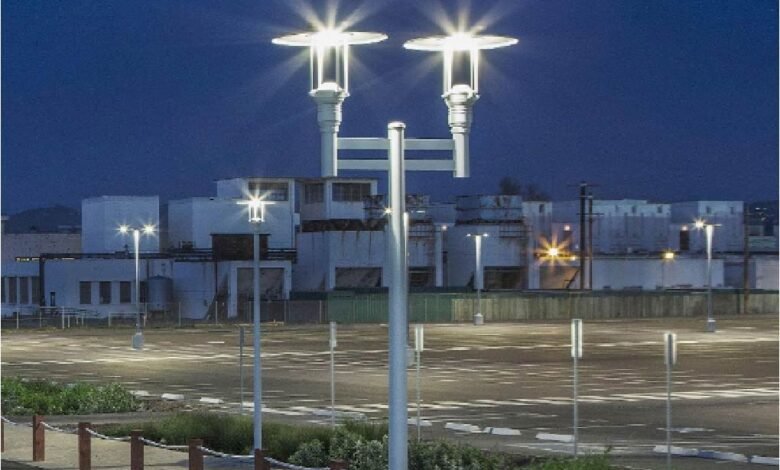
Achieving effective outdoor security is not merely a matter of maximizing raw lumens; it requires absolute optical uniformity. High-contrast transitions between brilliant glare and deep shadow—frequently called the “zebra-stripe effect”—impair human night vision and obscure security vulnerabilities.
Engineering layouts aligned with IES RP-20-14 (Lighting for Parking Facilities) and CIBSE SLL Code for Lighting establish crucial safety baselines:
- Photometric Uniformity Ratios: High-traffic parking structures and pathways require an average-to-minimum illuminance ratio of 3:1 or lower, ensuring consistent ground-plane illumination without dark hiding niches.
- Target Illuminance Levels: Maintaining minimum ground illuminance between 10 to 25 lux (1 to 2.5 foot-candles) across pedestrian walkways eliminates trip-and-fall hazards and supports institutional duty-of-care obligations.
- Color Rendering Index (CRI): Moving from low-pressure sodium fixtures (CRI < 30) to high-fidelity commercial LEDs (CRI ≥ 70 to 80) renders true surface colors, enabling eyewitnesses and security personnel to accurately identify vehicle paint codes and clothing colors.
- Correlated Color Temperature (CCT): Selecting a crisp 4000K to 5000K CCT stimulates scotopic visual response, enhancing human peripheral reaction speed and clarity across surveillance recordings.
Compliance with Modern Safety Standards
Uncontrolled light distribution leads to costly municipal citations, neighbor disputes, and disruptive environmental glare. Commercial facilities must align with Crime Prevention Through Environmental Design (CPTED) principles while respecting international dark-sky preservation frameworks.
Modern optical engineering resolves these competing demands through precision beam-shaping technology:
- BUG Rating Optimization: Luminaires classified under the IESNA TM-15-11 BUG system strictly limit Backlight (B), Uplight (U), and Glare (G), ensuring zero direct upward light emission (U0 rating).
- Targeted Optical Distributions: Employing precision polymethyl methacrylate (PMMA) refractive lenses allows tailored beam distributions—such as Type III for perimeter pathways or Type V for wide parking fields—directing photons exclusively onto target surfaces.
- Glare Suppression & Cutoff: Full-cutoff luminaire geometries shield driver eyes from high-angle beam glare, preserving motorist sightlines along adjacent public roadways and arterial corridors.
Smart Lighting Integration: The Future of Facilities
Outdoor commercial illumination has evolved from disconnected hardware into an intelligent, data-driven node within integrated Building Management Systems (BMS). Modern commercial fixtures natively support networked controls and digital dimming protocols.
Integrating intelligent controls transforms exterior fixtures into dynamic energy management assets:
- Continuous Digital Dimming: Incorporating 0–10V or DALI-2 (Digital Addressable Lighting Interface) drivers permits smooth lumen adjustments without chromaticity shifting or diode flicker.
- Bi-Level Occupancy Sensing: Integrated microwave or passive infrared (PIR) sensors automatically throttle output down to 20% to 30% standby power during quiet hours, ramping to 100% capacity within milliseconds upon vehicle or human entry.
- Photocell & Astronomical Time Clocks: Solid-state digital photocells prevent daylight burn hours, dynamically adjusting dusk-to-dawn schedules based on geographic coordinates and ambient ambient daylight harvesting.
- Autonomous Solar-Hybrid Nodes: For remote property boundaries and overflow parking lots where underground conduit trenching is economically non-viable, standalone solar-hybrid LED luminaires utilizing LiFePO4 battery storage eliminate trenching capital costs entirely.
Environmental Certifications and Brand Reputation
Modernizing your property’s exterior is not just about immediate utility savings; it plays a pivotal role in broader corporate sustainability goals. Upgrading to highly efficient outdoor systems can significantly contribute to earning prestigious green building credentials, such as the LEED (Leadership in Energy and Environmental Design) certification, which has been proven to increase the market value and tenant retention rates of commercial real estate globally.
High-efficiency outdoor retrofits directly satisfy critical credits within green building assessment models:
- LEED v4/v4.1 Building Operations and Maintenance: Projects capture points within Energy & Atmosphere (Credit: Minimum Energy Performance) and Sustainable Sites (Credit: Light Pollution Reduction) by pairing high efficacy with zero uplight.
- BREEAM Infrastructure Assessment: In European markets, exterior retrofits fulfill criteria under Ene 01 (Reduction of Energy Consumption) and Pol 04 (Reduction of Night Time Light Pollution).
- Scope 2 Emissions Auditing: Lowering baseload exterior electricity consumption reduces reported indirect greenhouse gas emissions under standard corporate ESG disclosure frameworks.
- Real Estate Premium Capture: Institutional logistics parks and Class-A office campuses certified under recognized green standards regularly command a 4% to 9% rental rate premium over non-certified assets.
Conclusion
Energy-efficient exterior lighting is no longer a peripheral facility maintenance task; it is an active driver of operational profitability, risk management, and environmental compliance. Replacing obsolete HID arrays with precision-engineered, thermally balanced LED luminaires slashes baseline electrical consumption, eliminates recurring maintenance cycles, and elevates perimeter security.
Facility managers, asset owners, and operations directors should initiate a structured photometric and energy audit of their exterior properties. By identifying lighting dead-zones, calculating total cost of ownership, and leveraging available regional decarbonization incentives, commercial stakeholders can modernize their infrastructure while delivering immediate bottom-line returns.