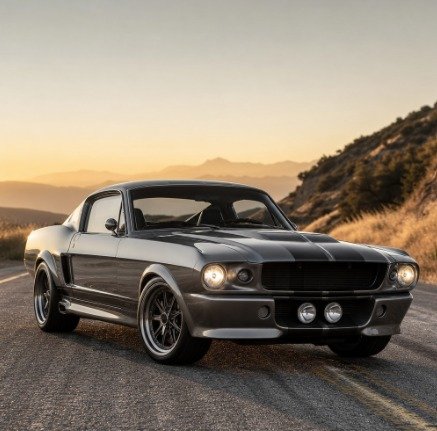
Few automotive legacies carry as much cultural weight as the Ford Mustang. From its debut in 1964 to the turbocharged and supercharged variants rolling off assembly lines today, the Mustang has always represented something deeper than transportation — it is an American statement. But as modern engineering continues to push horsepower figures into the stratosphere, a quieter, more deliberate movement has been gaining momentum: the art of restoring and reimagining classic Ford muscle cars with the precision and performance of contemporary technology. This intersection of heritage and innovation is where the most compelling automotive stories are being written today.
The Enduring Appeal of Classic American Muscle
There is something viscerally satisfying about a 1960s or early 1970s Mustang that no modern vehicle can fully replicate. The proportions are honest, the lines are purposeful, and the mechanical simplicity invites a kind of engagement that has been engineered out of most contemporary automobiles. Collectors and enthusiasts have long understood this, but a new generation of buyers is discovering it too — people who want the soul of a classic car without sacrificing reliability, safety, or performance.
This demand has given rise to a specialized segment of the automotive industry focused on what are often called “continuation cars” or high-end restomod builds. These are not mere restorations. They are ground-up reconstructions that honor original styling while incorporating modern drivetrains, suspension geometry, braking systems, and interior appointments. The result is a vehicle that looks like it belongs in 1968 but drives like something built for the 21st century.
Understanding the Performance Spectrum
When discussing performance in the context of classic Ford muscle, it is important to recognize the full spectrum of what that term encompasses. On one end, you have factory-correct restorations where originality is paramount. On the other, you have heavily modified builds where the original body is essentially a canvas for a completely reimagined machine. Between these poles lies a rich middle ground where builders balance authenticity with capability.
Engine Choices and Power Outputs
Engine selection is often the most consequential decision in any classic Ford build. Period-correct V8s carry enormous sentimental and collector value, but modern crate engines — particularly Ford’s own lineup of performance powerplants — offer reliability and output figures that vintage engines simply cannot match without significant investment. Many builders opt for a modern fuel-injected V8 that retains the classic exhaust note while delivering consistent, predictable power across a broad RPM range. This approach allows drivers to enjoy the car without the anxiety that often accompanies a numbers-matching restoration on public roads.
Suspension and Chassis Upgrades
Original Mustang suspension geometry was a product of its era — functional for the roads and driving expectations of the 1960s, but not optimized for modern performance driving. Contemporary builders frequently replace the entire front and rear suspension with purpose-built systems that dramatically improve handling, reduce body roll, and provide a more communicative steering feel. Coilover setups, upgraded sway bars, and modern rack-and-pinion steering conversions are common upgrades that transform the driving dynamics without altering the car’s visual identity.
The Modern Mustang Benchmark
To appreciate how far classic builds have come, it helps to understand where the modern Mustang stands. The S650 generation represents Ford’s most sophisticated interpretation of the nameplate yet, with a range of powertrains spanning from turbocharged four-cylinders to the thunderous supercharged V8 found in the Shelby GT500. For enthusiasts curious about how each variant stacks up, a detailed breakdown of every S650 Ford Mustang ranked by horsepower offers an illuminating look at the breadth of performance options available from the factory today. These figures serve as a useful benchmark when evaluating what a well-executed restomod can achieve in comparison.
Diesel Performance and the Broader Enthusiast Culture
The Ford performance community extends well beyond gasoline-powered muscle cars. Truck enthusiasts, particularly those running the 6.7 Power Stroke diesel, represent a passionate and technically sophisticated segment of the Ford ownership base. Modifications in this space often involve emissions system upgrades and exhaust flow improvements. For those exploring this territory, understanding what Ford diesel owners should know before upgrading their DPF delete pipe is an essential first step before making any changes to the exhaust or emissions system. This kind of informed approach — researching thoroughly before modifying — reflects the broader ethos of serious Ford enthusiasts across all segments.
Revology Cars: Where Classic Meets Contemporary
Among the builders operating at the highest level of this craft, few have earned the reputation for quality and authenticity that defines the work coming out of Orlando, Florida. Revology Cars has established itself as a premier manufacturer of continuation Mustangs, producing meticulously crafted 1964½ through 1970 Mustang replicas that combine period-correct styling with thoroughly modern mechanicals. Every vehicle is built to order, with customers selecting from a range of powertrain, interior, and exterior configurations that allow for genuine personalization without compromising the integrity of the original design language.
What distinguishes this approach from a typical restoration shop is the manufacturing philosophy. Rather than working from aged donor vehicles that carry decades of wear, fatigue, and hidden damage, the process begins with new components engineered to modern tolerances. The result is a car that not only looks correct but behaves with the consistency and dependability that classic car ownership has historically struggled to deliver.
The Value Proposition of a Continuation Car
For buyers weighing the decision between a high-quality original restoration and a purpose-built continuation car, the calculus often comes down to how the vehicle will be used. A concours-level restoration is a museum piece — extraordinary to look at, but psychologically difficult to drive with any frequency. A continuation car, by contrast, is designed to be driven. It invites daily use, weekend canyon runs, and cross-country touring without the constant concern over mechanical fragility or the irreplaceable nature of original components. For many enthusiasts, this freedom is the most compelling feature of all.
Conclusion: A Living Legacy
The story of Ford performance is not a single narrative — it is a collection of parallel threads running from the original pony car revolution of the 1960s through the turbocharged and supercharged present, and into the carefully crafted continuation vehicles that allow new generations to experience classic design without compromise. Whether you are drawn to the raw horsepower figures of the latest factory Mustangs, the mechanical culture surrounding Ford’s diesel trucks, or the refined artistry of a hand-built continuation car, the common thread is a passion for vehicles that do more than move people from place to place. They move people, full stop. That emotional resonance is what has kept the Ford performance community vital for more than six decades, and it shows no sign of fading.