Enterprises today are sitting on mountains of data such as transaction logs, customer behavior records, operational metrics, and supply chain signals, and most of it goes completely untapped. The volume is staggering, but volume alone means nothing without the right systems to make sense of it.
That gap between raw data and real business decisions is exactly what a reliable big data analytics service is designed to close. Malaysian enterprises, in particular, are waking up to this reality fast. According to an IDC study commissioned by Malaysia Digital Economy Corporation (MDEC), the big data analytics market in Malaysia is expected to grow to US$1.9 billion by 2025, up from US$1.1 billion in 2021: a clear signal that organizations here are ready to compete on data.
The question is no longer whether to invest in analytics. The question is how to do it right.
What “Raw Data” Actually Means for Enterprises
Raw data is everything an organization collects before any processing happens — server logs, CRM entries, IoT sensor readings, social media interactions, financial records, and mobile app events. On its own, that data tells almost nothing useful.
A retail chain might see 50 million customer transactions per month. Without the right infrastructure, that is just noise. With a proper big data analytics service layered on top, those same transactions reveal which products drive repeat purchases, which store locations are underperforming, and which customer segments are quietly drifting toward a competitor.
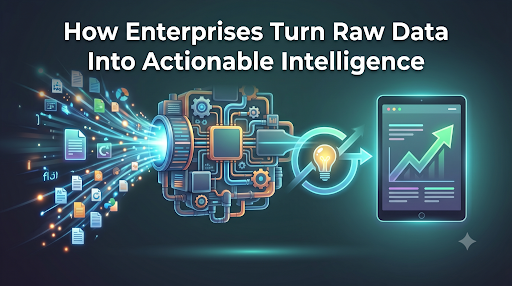
The transformation from noise to insight follows a consistent process, and understanding it is the first step to getting real value from enterprise data.
The Five-Stage Pipeline From Data to Decision
1. Data Ingestion and Collection
Data has to be pulled from wherever it lives like databases, APIs, IoT devices, cloud platforms, and third-party tools. Modern ingestion systems handle both structured data like spreadsheets and relational databases, and unstructured data like emails, images, and sensor streams. Batch ingestion works well for historical analysis, while real-time streaming is essential when decisions need to happen in seconds, such as fraud detection in financial services or dynamic pricing in e-commerce.
2. Data Storage and Management
Once collected, data needs a home that can scale. Cloud-based data lakes and data warehouses are now the standard for enterprise-scale storage, allowing organizations to store petabytes of data affordably while keeping it accessible for analysis.
Amazon Web Services recently announced a US$6.2 billion investment in Malaysia through 2038, including the launch of the AWS Asia Pacific (Malaysia) Region by enabling local enterprises to deploy advanced AI and machine learning applications directly from Malaysian data centres. That level of infrastructure commitment signals that cloud-native data storage is not just available in Malaysia; it is accelerating at pace.
3. Data Processing and Transformation
Raw data is messy by nature. Inconsistent formats, missing values, and duplicate records all need to be cleaned and standardized before meaningful analysis can happen. This stage is commonly called ETL — Extract, Transform, Load — and it is where data engineering work pays off. Automated data pipelines handle this at scale, compressing what used to take analysts days to clean manually into a process that runs in minutes with the right tooling.
4. Analytics and Intelligence Generation
This is where the real value emerges. Enterprises use a combination of descriptive, diagnostic, predictive, and prescriptive analytics to build a complete picture. Descriptive analytics explains what happened — say, sales dropped 12% last quarter. Diagnostic analytics investigates why, perhaps a supply chain delay caused stockouts across two key product lines. Predictive analytics then forecasts what is likely to happen next, and prescriptive analytics goes one step further by recommending the specific action to take.
Advanced implementations weave machine learning models directly into this layer, enabling the system to improve its accuracy over time without constant manual intervention.
5. Visualization and Decision Delivery
Insights buried inside a database help no one. Enterprise analytics platforms surface findings through dashboards, automated reports, and real-time alerts, making data visible and usable for the people who need to act on it. Business leaders do not need to understand the underlying algorithm so they need to see the recommendation clearly and trust the data behind it.
Why Most Enterprise Data Projects Fail
Most organizations collect far more data than they can use effectively, and that gap is not always a technology problem.
According to a WEF survey, 50% of employees globally will need reskilling by 2025 due to increasing technology adoption. In Malaysia specifically, 65% of employees consider digital skills essential, yet a significant mismatch exists between the skills employers need and what the workforce currently has. That skills gap is one reason enterprise analytics projects stall before they deliver value.
Beyond talent, the other common failure points follow a familiar pattern. Siloed data is a persistent issue when finance does not share data with operations and sales does not integrate with logistics, no one sees the full picture. Projects also fail when there is no clear business question driving the work. Analytics for the sake of analytics wastes budget and energy. The highest-impact projects start with a specific, measurable question rather than a vague mandate to “explore the data.”
Infrastructure mismatch is another culprit. Spreadsheet-era tools simply cannot handle enterprise-scale data volumes, and organizations that delay investing in purpose-built big data infrastructure hit hard ceilings quickly. Finally, without executive buy-in, data culture never takes root at scale. If leadership does not actively use data to make decisions, the analytics investment stalls at the departmental level and never drives organization-wide change.
Industries Benefiting Most From Big Data Analytics Services
Financial Services and Banking
The banking and telecommunications sectors together contribute nearly a third of Malaysia’s total data-driven spending, and the results are visible. Banks use analytics to detect fraud in real time, personalize loan offerings, and predict credit risk at scale. A transaction that might take a human analyst hours to flag as suspicious can be intercepted by a well-trained model in milliseconds.
Retail and E-Commerce
Platforms like Shopee and Lazada have built entire recommendation engines on big data analytics, but enterprise retailers beyond the platform giants are catching up fast. Inventory optimization, customer lifetime value modeling, and demand forecasting are now within reach for mid-market Malaysian retailers that partner with the right analytics service provider.
Healthcare
Predictive analytics in healthcare helps optimize resource allocation and treatment strategies, improving patient outcomes and strengthening public health resilience. Malaysian hospitals and healthcare groups are increasingly using data to reduce readmission rates, forecast patient volumes, and streamline procurement decisions.
Manufacturing and Logistics
Smart factories generate enormous volumes of sensor data from production lines, and analytics platforms are using that data to identify equipment failure before it happens, reduce unplanned downtime, and optimize throughput. For logistics companies, route optimization powered by real-time data cuts both fuel costs and delivery windows at the same time.
What to Look For in a Big Data Analytics Service Partner
Not every analytics provider is built for enterprise scale. Choosing the wrong partner can lock an organization into platforms that cannot grow with the business, or worse, introduce data quality problems that corrupt every downstream insight.
The right partner brings end-to-end capability, covering everything from data ingestion to final visualization rather than just one piece of the stack. Cloud-native infrastructure expertise matters too, since data analytics at enterprise scale lives in the cloud and requires deep knowledge of platforms like AWS, Microsoft Azure, and Google Cloud to design architectures that are both powerful and cost-efficient.
AI and machine learning integration separates good analytics from great analytics. Descriptive reporting tells what happened; AI-powered analytics tells what to do next. Security and compliance must also be built in from the start, not added as an afterthought. Malaysian enterprises operate under PDPA (Personal Data Protection Act) requirements, and any system handling customer data needs data governance embedded by design. Finally, industry-specific experience matters enormously because the analytics challenges in financial services look nothing like those in manufacturing, and a partner with proven work across multiple sectors brings that context to every engagement.
How Zchwantech Helps Enterprises Get More From Their Data
Zchwantech’s AI and Data Intelligence Platforms service is built specifically for organizations that need more than dashboards. The team works with enterprises to design full data pipelines, from ingestion and storage through to predictive modeling and decision-layer delivery.
As a certified AWS partner with over 100 AWS certifications, Zchwantech brings both the cloud infrastructure expertise and the analytics depth to help Malaysian enterprises close the gap between raw data and actionable intelligence. The team has delivered solutions across sectors including financial services, government institutions, and enterprise technology, applying the same rigorous, outcome-driven approach each time.
MDEC has emphasized that big data analytics is central to Malaysia’s digital economy, driving the growth of adjacent technologies like AI, IoT, and advanced automation. Zchwantech’s solutions sit at exactly that intersection which combines cloud scalability, AI-driven modeling, and practical business intelligence delivery into a single, cohesive engagement.
For enterprises ready to stop guessing and start making decisions backed by evidence, the first step is a conversation about where data is being generated, where it is being lost, and what decisions it should be driving.
Reach out to the Zchwantech team at sales@zchwantech.com to explore how a purpose-built big data analytics service can turn enterprise data into a genuine competitive advantage.