The Olfactory-Limbic Shortcut: Why Your Brain Responds to Scent Before You Even Think

The Fastest Sense You Never Think About
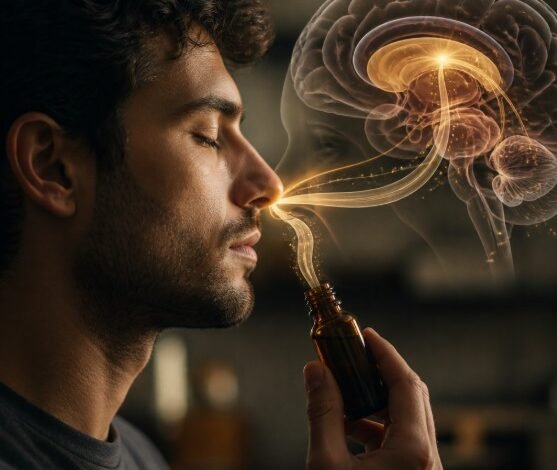
Of all the human senses, smell is the only one that bypasses the brain’s rational processing center entirely. When you hear a sound or see an image, that information travels through the thalamus — the brain’s relay station — before reaching the cortex for interpretation. Scent does not follow this route. Odor molecules bind to receptors in the nasal epithelium, and signals travel directly to the olfactory bulb, which sits in immediate proximity to the amygdala and hippocampus. These two structures govern emotional response and memory formation. The result is a neurological shortcut that no other sense possesses, and it explains why a single whiff of lavender can dissolve tension before your conscious mind has registered anything at all.
Understanding the Olfactory-Limbic Connection
The limbic system is often described as the emotional brain. It regulates fear, pleasure, motivation, and the formation of long-term memories. Because the olfactory bulb feeds directly into this system, scent carries an emotional charge that is both immediate and deeply personal. This is why certain fragrances feel comforting or unsettling in ways that are difficult to articulate — the emotional response arrives before the analytical mind can frame it in language.
The Amygdala’s Role in Scent-Triggered Emotion
The amygdala processes emotional significance. When a scent signal arrives, the amygdala evaluates it almost instantaneously, tagging it with an emotional valence — pleasant, threatening, neutral. This evaluation happens in milliseconds. Research has consistently shown that certain aromatic compounds, particularly those found in essential oils like bergamot, ylang-ylang, and frankincense, activate the amygdala in ways that reduce cortisol output and promote parasympathetic nervous system activity. In practical terms, this means your body begins to physically relax before you have consciously decided to do so.
Memory, Scent, and the Hippocampus
The hippocampus, which sits adjacent to the amygdala, is responsible for encoding and retrieving memories. Because olfactory signals reach both structures simultaneously, scent and memory become tightly intertwined. This is the neurological basis for what is commonly called the Proustian memory effect — the phenomenon where a smell instantly transports you to a specific moment in the past. Aromatherapy practitioners leverage this connection deliberately, using consistent scent associations to anchor states of calm, focus, or restoration in the nervous system over time.
Why Scent Shifts Mood Faster Than Any Other Stimulus
Speed is the defining characteristic of olfactory processing. Visual stimuli require approximately 150 milliseconds to reach conscious awareness. Auditory stimuli are slightly faster. Olfactory signals, however, reach the limbic system in under 100 milliseconds. This is not a marginal difference — it represents a fundamentally different architecture of perception. The practical implication is significant: by the time you consciously register that a room smells of eucalyptus or rose, your nervous system has already begun adjusting its state. Mood, in this context, is not a decision. It is a biological response that scent can initiate without permission.
Neurotransmitters and Aromatic Compounds
Certain aromatic compounds interact with neurotransmitter systems in measurable ways. Linalool, a terpene found in lavender, has been shown to modulate GABA receptors — the same receptors targeted by anti-anxiety medications — producing a calming effect without sedation. Limonene, present in citrus oils, appears to increase serotonin and dopamine availability in the brain’s reward pathways. Rosemary’s primary compound, 1,8-cineole, has been linked to increased acetylcholine activity, which supports alertness and cognitive clarity. These are not anecdotal claims; they are documented in peer-reviewed neuroscience and pharmacology literature, lending scientific credibility to practices that have existed for thousands of years.
Aromatherapy as a Practical Application of Olfactory Science
Understanding the olfactory-limbic pathway transforms aromatherapy from a wellness trend into a scientifically grounded practice. To truly understand how aromatherapy works, it is essential to recognize that its effects are not placebo-driven or purely psychological — they are rooted in the direct biochemical interaction between volatile aromatic molecules and the brain’s emotional and autonomic systems. When essential oils are inhaled, their molecular compounds enter the nasal cavity, stimulate olfactory receptors, and initiate a cascade of neurological and physiological responses that can meaningfully alter stress levels, sleep quality, and emotional regulation.
Topical Application and the Skin-Brain Axis
Beyond inhalation, aromatic compounds applied to the skin can be absorbed transdermally, entering the bloodstream and reaching systemic circulation. This dual pathway — inhalation and absorption — is why aromatherapy-infused skincare products occupy a unique position in wellness. They engage the olfactory-limbic system through scent while simultaneously delivering bioactive compounds through the skin. For those building a holistic self-care routine, understanding a beginner’s guide to starting a skin care routine can help integrate aromatherapy-based products in a way that maximizes both skin health and emotional wellbeing.
The Intersection of Scent, Skin, and Aesthetic Wellness
The relationship between emotional wellbeing and physical appearance is increasingly recognized in aesthetic medicine. Chronic stress elevates cortisol, which accelerates collagen degradation, disrupts skin barrier function, and contributes to premature aging. Practices that reduce stress — including aromatherapy — therefore have indirect but genuine benefits for skin quality. This is why the conversation around aesthetic treatments and holistic wellness is converging. Those exploring options like facial fillers for a more refreshed and youthful appearance are increasingly pairing clinical treatments with lifestyle practices that support skin health from the inside out, including stress management through scent-based therapies.
Bonjil: Where Aromatherapy Meets Skincare Intelligence
Bonjil approaches the intersection of scent and skin with a level of scientific rigor that distinguishes it from conventional beauty brands. Rather than treating fragrance as a cosmetic afterthought, Bonjil formulates with an understanding of how aromatic compounds interact with both the skin and the nervous system. Each product is designed to deliver a sensory experience that is purposeful — not merely pleasant. The brand’s commitment to transparency means that customers understand what they are applying, why it works, and how it supports their broader wellbeing. For anyone seeking skincare that functions on multiple levels simultaneously, Bonjil represents a thoughtful and evidence-informed choice.
Conclusion: Scent Is Not Subtle It Is Structural
The olfactory-limbic shortcut is not a curiosity of neuroscience — it is a fundamental feature of human biology that has profound implications for how we manage mood, stress, and wellbeing. Scent reaches the emotional brain faster than any other sensory input, triggering physiological changes that precede conscious awareness. This makes aromatherapy one of the most direct and efficient tools available for emotional regulation. When integrated thoughtfully into a skincare routine, it becomes something more than self-care — it becomes a daily practice of neurological recalibration, one breath at a time.