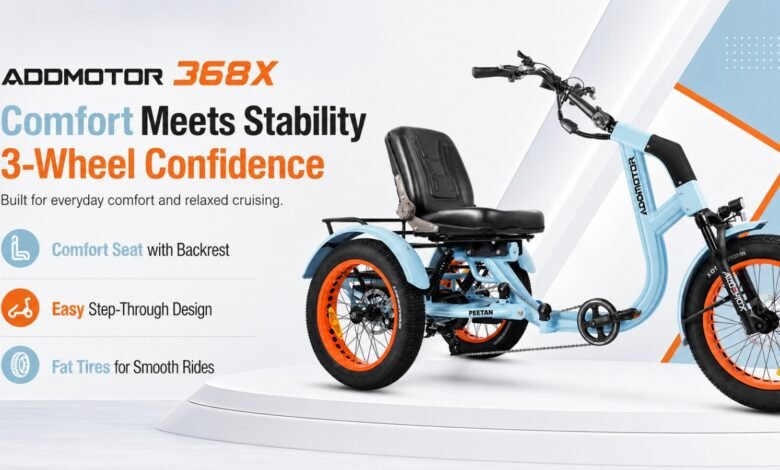
Motor wattage is often the first number shoppers notice when comparing electric trikes. However, a printed power rating does not fully explain how a trike will perform when starting with cargo, climbing an incline, or moving through repeated stop-and-go traffic. The Addmotor M-368X takes a system-based approach. It combines a 750W rated rear-drive brushless motor, up to 1,400W peak output, 90 Nm of torque, a 25A controller, and a precision differential.
This matters because an electric trike carries more weight and creates more rolling resistance than a conventional two-wheel e-bike. The M-368X supports a total payload of 380 pounds, including a rider capacity of 280 pounds and up to 100 pounds on the rear cargo rack. Its motor therefore needs to do more than produce an attractive peak figure. It must deliver controlled starting force, reliable assistance, and stable low-speed performance.
A Genuine 750W Motor Built for Real Loads
The M-368X uses a 750W rated rear-drive brushless hub motor with a peak output of 1,400W. Rated power reflects normal operating capability, while peak output provides extra support during demanding moments such as accelerating from a stop or riding up a steeper section of road.
With 90 Nm of torque, the motor can create strong turning force at the rear wheel. For riders carrying groceries, equipment, or other cargo, this helps the trike move away from a stop without feeling excessively slow or strained. The rear-drive layout also produces a natural pushing sensation and keeps motor power away from the steering wheel.
A 25A controller on Addmotor’s EB 2.0 platform manages the relationship between the battery and motor. Controller calibration affects acceleration, efficiency, heat, and throttle behavior. On a three-wheel vehicle, smooth delivery is especially important. Sudden power can feel uncomfortable during a turn, while weak delivery can make a loaded trike difficult to start.
Torque-Sensing Assistance Improves Control
The M-368X uses a high-precision torque sensor that measures how much force the rider applies to the pedals. Assistance is then adjusted proportionally in real time.
This creates a more natural experience than a basic cadence-only system. Pedal gently and the motor provides mild support. Push harder and the assistance increases. That response is useful on residential streets, shared paths, and crowded areas where riders need accurate low-speed control.
Seven pedal-assist levels give the rider a wide adjustment range. A half-twist throttle is also included for moments when starting without immediate pedaling is more convenient. Together, the torque sensor, PAS system, throttle, and controller make the 750W motor easier to use rather than simply more powerful.
The Differential Makes Rear-Motor Power More Useful
During a turn, the outside rear wheel must travel farther than the inside wheel. A basic solid-axle setup can make cornering feel stiff or cause tire scrub. The M-368X includes a precision speed differential that allows the rear wheels to manage different rotational speeds more smoothly.
This is an important partner to the rear-drive motor. It helps the trike retain balanced traction while turning instead of forcing both wheels to behave identically. The universal-joint steering system also uses a proprietary steel gear-mesh structure that separates steering movement from suspension action.
The minimum turning radius is approximately two meters. Riders should still reduce speed before cornering, but the differential and steering design make the M-368X more manageable than a trike that relies on a simple rigid rear axle.
A Battery and Electrical System That Support the Motor
Strong motor output places greater demand on the battery and wiring. The M-368X uses a 48V 20Ah Samsung lithium-ion battery with UL 2271 certification. It also features full-potting encapsulation, meaning protective material fills internal gaps around the cells.
This structure helps stabilize the battery against vibration and improves resistance to moisture, dust, and concentrated heat. It is especially relevant when the drivetrain briefly draws higher power during acceleration or climbing.
Under favorable conditions, range can reach approximately 85–90 miles in PAS 1. Actual results depend on terrain, rider weight, cargo, temperature, tire pressure, speed, and assist level. Charging takes about eight to ten hours with the supplied 48V 2A charger.
Full internal cable routing keeps the trike visually clean and protects wiring from exposure. The use of substantial conductive wiring also helps reduce unnecessary resistance and heat during higher-current operation.
Tires, Suspension, and Frame Help Transfer Power
The M-368X rides on 20 × 4.0-inch thickened virgin-rubber fat tires mounted on dual-layer rims. Their wide contact patch supports traction when the rear motor produces strong torque. Compared with low-cost recycled-rubber compounds, properly formulated virgin rubber generally provides better elasticity, grip, and resistance to premature cracking.
The front suspension uses an Addshox triple-clamp fork with 80 mm of travel and independent front suspension. A rear coil shock adds further support. By helping the wheels remain in contact with uneven ground, the suspension improves comfort and allows motor power to reach the road more consistently.
The integrally formed aerospace-grade 6061 aluminum alloy frame gives the drivetrain a rigid, corrosion-resistant foundation. This is especially important on a 148-pound trike carrying a substantial rider and cargo load.
Addmotor M-368X Product Specifications
| Specification | Addmotor M-368X |
| Vehicle Type | Semi-recumbent full-suspension electric trike |
| Motor | 750W rated rear-drive brushless hub motor |
| Peak Output | Up to 1,400W |
| Torque | 90 Nm |
| Controller | 25A controller with EB 2.0 platform |
| Pedal-Assist Sensor | High-precision torque sensor |
| PAS and Throttle | 7 PAS levels plus half-twist throttle |
| Battery | 48V 20Ah Samsung lithium-ion battery |
| Battery Certification | UL 2271 |
| Battery Construction | Full-potting encapsulation |
| Estimated Range | Up to 85–90 miles in PAS 1 |
| Charging Time | Approximately 8–10 hours |
| Differential | Precision speed differential |
| Steering System | Universal-joint steering |
| Minimum Turning Radius | Approximately 2 meters |
| Frame Material | Integrally formed aerospace-grade 6061 aluminum alloy |
| Front Suspension | 80 mm Addshox independent front suspension |
| Rear Suspension | Coil shock |
| Tires | 20 × 4.0-inch thickened virgin-rubber fat tires |
| Rims | Dual-layer rims |
| Braking System | Triple mechanical disc brakes |
| Parking Brake | Included |
| Seat Cushion | 17.3 × 13.7-inch PU cushion |
| Backrest Adjustment | 90° upright to 170° semi-reclined |
| Recommended Rider Height | 5’1″–6’7″ |
| Rider Capacity | 280 lb |
| Rear Rack Capacity | 100 lb |
| Total Payload Capacity | 380 lb |
| Vehicle Weight | Approximately 148 lb |
| Price | $3,299 USD |
Who Is This Motor Setup For?
The M-368X is designed for riders who want three-wheel stability without accepting weak electric assistance. Its drivetrain is especially suitable for heavier riders, people who regularly carry cargo, riders living near moderate hills, and anyone who wants easier starts with less pedaling strain.
The semi-recumbent seating position also changes how acceleration feels. The large seat cushion and adjustable backrest support the rider’s body, while the automotive-style sliding footrest helps fit riders from about 5 feet 1 inch to 6 feet 7 inches. Instead of balancing over a narrow saddle, the rider can remain supported while the motor delivers assistance.
The drivetrain can also be useful for riders who make frequent stops. Starting a heavy trike repeatedly can require considerable physical effort, especially when the rear rack is loaded. The half-twist throttle can help initiate movement, after which the rider can begin pedaling and allow the torque sensor to regulate assistance naturally.
This combination makes the M-368X more versatile than a trike designed only for flat, lightly loaded recreational riding. The motor has enough rated output to support everyday transportation, while the control system prevents that power from becoming unnecessarily abrupt.
Why Rated Power Matters More Than Marketing Claims
Not every motor promoted as a 750W unit provides the same internal construction or sustained performance. Some manufacturers highlight a temporary peak figure while giving little information about rated output, torque, controller capacity, or thermal management.
The M-368X clearly distinguishes between its 750W rated output and its maximum peak output of 1,400W. This makes it easier for buyers to understand what the drivetrain is designed to provide during normal riding and what additional power may become available for short periods.
Motor size, winding construction, controller capacity, wiring quality, and battery discharge capability all influence actual performance. A large advertised number has limited value when the surrounding electrical system cannot support it. Addmotor instead pairs the motor with a 25A controller, a 48V battery, high-quality wiring, and a torque-based assist system.
More Than a Wattage Number
The main strength of the Addmotor M-368X is not simply its 1,400W peak figure. It is the way the trike combines a genuinely rated 750W rear-drive motor with 90 Nm of torque, a 25A controller, torque-sensing assistance, a differential, a protected Samsung battery, wide tires, full suspension, and a rigid aluminum frame.
These supporting components determine whether power feels useful, smooth, and dependable. They also affect how the trike performs when rider weight, cargo, road conditions, and terrain create real demands.
For shoppers comparing adult electric trikes, the M-368X offers a practical lesson: do not judge a vehicle by one wattage number. Look at rated output, torque, controller capacity, sensor type, battery construction, traction, steering, and frame design together.
The Addmotor M-368X stands out because its motor is not an isolated marketing feature. It is the center of a coordinated drivetrain built for controlled, confident, and practical three-wheel riding.