Outdoor spaces often receive plenty of attention during the day. Homeowners carefully choose paving, plants, furniture, fencing and decorative details, only for much of that work to disappear once the sun goes down.
Good outdoor lighting can bring those spaces back to life, but brighter does not necessarily mean better. In many gardens and residential properties, some of the most useful lighting is positioned much closer to the ground.
Low-level lighting can define walkways, make driveways easier to navigate, highlight landscaping and create a comfortable atmosphere without flooding the entire property with light. Used thoughtfully, it can make even a simple outdoor space feel much more finished.
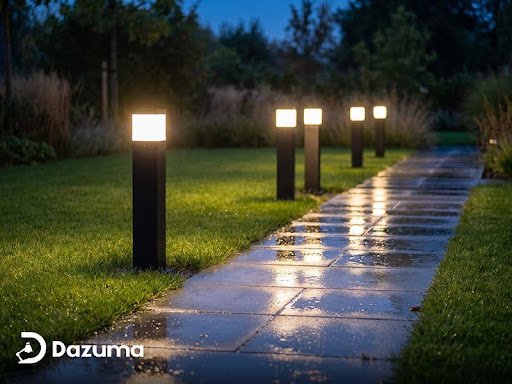
Low-level lighting can define paths and landscape areas without overwhelming the rest of the outdoor space.
Start With the Way People Move Through the Property
Before thinking about decorative lighting, consider how people actually use the outdoor space.
Where do you walk after parking the car? Which route do visitors follow to reach the front entrance? Is there a side path leading to the backyard? Are there steps between the patio and garden?
These routes are natural starting points because lighting can improve both their appearance and usability.
Rather than trying to illuminate every inch of a path, concentrate on locations where people need visual guidance. Curves, steps, changes in paving and intersections between different walkways are particularly useful places for light.
This usually produces a cleaner result than placing identical fixtures at very short intervals.
Why Lighting Height Makes Such a Difference
The height of an outdoor light changes both what it illuminates and how the space feels.
A fixture mounted high on a wall can cover a large area, which is useful for general illumination. A lower fixture has a more focused relationship with the ground, nearby planting and the people moving through the space.
That makes lower lighting particularly effective around walkways, driveways and garden edges.
It can also help create visual depth. Instead of seeing one evenly bright yard, you see a series of softly illuminated areas separated by darker sections. This contrast can make the landscape feel larger and more interesting.
Use Bollard Lighting to Define Paths and Boundaries
One practical option for low-level outdoor illumination is the use of bollard lights. These vertical fixtures can help establish the edges of pathways, driveways, garden entrances and other transition areas while contributing to the overall design of the landscape.
They are especially useful in places where there is no nearby wall or ceiling from which to mount a conventional fixture.
Placement matters, however. Installing too many can make a residential walkway feel overly formal or commercial. In many cases, a smaller number of carefully positioned fixtures is enough to establish the route.
Consider the viewing angle as well. The light source should ideally help illuminate the ground without producing uncomfortable glare when someone approaches.
Avoid the Airport Runway Effect
One of the most common mistakes with pathway lighting is perfect symmetry.
Placing lights directly opposite each other at regular intervals can create two straight lines that resemble a runway. While this may be appropriate in certain formal landscapes, it can feel unnecessarily rigid around an ordinary home.
Try staggering fixtures instead.
For example, place one light near a planting bed on the left side of the path and the next farther ahead on the right. This provides useful illumination while making the arrangement feel more integrated with the landscaping.
The exact spacing should depend on the amount of light produced by each fixture, the width of the path and the surrounding environment rather than following a fixed formula.
Let Plants Become Part of the Lighting Design
Low-level lighting does not have to focus entirely on paving.
A fixture positioned beside ornamental grasses, shrubs or other planting can reveal textures that are barely noticeable during the daytime. Leaves and branches create shadows, giving the garden a completely different character after dark.
This effect is especially useful along the edge of a walkway. Instead of seeing only a bright strip of paving surrounded by darkness, the light can gently connect the path with the landscape around it.
Again, restraint matters. Highlight selected areas rather than trying to make every plant visible.
Think About the Driveway as Part of the Landscape
Driveways are highly practical spaces, but they also occupy a significant portion of many front yards.
At night, a completely dark driveway can make the approach to a house feel less welcoming. Carefully placed lighting can help define the route toward the garage or parking area without requiring one extremely bright floodlight.
Low-level fixtures positioned near important points such as curves, entrances or transitions can provide visual orientation while becoming part of the landscape design.
If the driveway runs close to bedrooms or neighboring properties, controlled lighting also makes it easier to illuminate the area that needs attention without unnecessarily spreading light elsewhere.
Match the Fixtures to the Architecture
Outdoor lights remain visible during the daytime, so their appearance matters even when they are switched off.
Minimal rectangular fixtures often complement modern homes, while traditional properties may work better with softer shapes or lantern-inspired details. The goal does not have to be an exact match between every exterior fixture.
Instead, look for a shared design language.
A consistent finish, similar proportions or repeated geometric details can connect wall lights, post lights and other outdoor fixtures without making everything identical.
Homeowners comparing different designs can browse lighting retailers such as Dazuma Lighting to see how contemporary and traditional fixture styles could relate to different architectural settings.
Do Not Ignore the View From Indoors
An outdoor lighting plan is often judged from the driveway or garden, but there is another important viewpoint: inside the house.
Large windows become dark surfaces at night when there is nothing visible outdoors. Adding subtle light to a path, tree or planting area can create a more interesting view from a living room or dining space.
This can make the garden feel visually connected to the interior even when nobody is outside.
Walk through the main rooms after dark and look through the windows before deciding where every fixture should go. You may discover that a small change outside significantly improves the atmosphere inside as well.
Use Less Light, but Put It in Better Places
It is easy to assume that improving outdoor visibility requires brighter fixtures. Often, the real solution is better placement.
A modest amount of light near a step can be more useful than a powerful fixture twenty feet away. Similarly, a low light beside a pathway can provide clearer visual guidance than a bright source mounted high above it.
Try to keep the light directed toward the surfaces that actually need it.
This helps reduce glare and prevents illumination from spilling unnecessarily into windows, neighboring properties or the sky.
Build the Lighting Plan Gradually
There is no need to complete an entire outdoor lighting project at once.
Start with the route people use most often, such as the path between the driveway and front door. Live with the lighting for several evenings and notice whether any areas still feel unclear or uncomfortable.
Then move on to the patio, garden or secondary pathways.
Working gradually makes it easier to understand what the property actually needs and reduces the temptation to install more fixtures than necessary.
Final Thoughts
Low-level outdoor lighting can have a surprisingly large influence on the way a home feels after sunset.
By defining pathways, marking important transitions, softly illuminating plants and helping people navigate the property, it combines practical function with visual design.
The most effective approach is usually not to make everything equally bright. Choose the places that matter, use light where it genuinely improves the space, and allow some areas to remain naturally darker.
When light is treated as part of the landscape rather than simply a way to remove darkness, an ordinary path, driveway or garden can become one of the most attractive parts of the property at night.