A search for the price of robot lawn mowers rarely ends with the sticker price. The harder questions come next. Does that number include installation, and will the mower actually cope with the yard outside the window?
For context, PCMag places robot lawn mower prices at roughly $600 to more than $5,000, with professional installation potentially adding hundreds. The more useful number, however, is the installed total for your yard, not the lowest price shown on a product page. [Source: PCMag, The Best Robot Lawn Mowers for 2026]
This pre-purchase checklist identifies the setup costs and yard limits that can change the number quoted at checkout, including boundary-wire labor, charging-station access, lawn layout, slope, and wear items.
What a Robot Lawn Mower Price Usually Includes
The number on a store card usually buys the mower and its charging station. Sometimes the box contains installation hardware too, but included parts are not the same as included labor. A low shelf price can remain low in a simple, powered, open yard. Add divided lawn zones and no nearby outdoor outlet, and the real cost can climb quickly.
Use one worksheet for every model and group the setup into three budget bands. A low-complexity setup is a simple, powered, open lawn that may need little beyond normal installation. A medium-complexity setup includes divided zones, narrow passages, obstacles, or an awkward dock location. A high-complexity setup may require professional boundary-wire installation or new outdoor power, creating the greatest cost uncertainty. Mark each cost as included, DIY, professional help, or not applicable, then ask sellers to separate equipment, installation, and site work in the quote.
| Cost line | What may change it | Question to settle before checkout |
| Mower and charging station | Coverage class, navigation system, and included hardware | Is every part needed for normal setup in the box? |
| Boundary setup | Wire length, edging, obstacles, crossings, soil, and labor | Does the model need a buried or pinned perimeter wire? |
| Charging-site work | Outdoor power, cable route, dock clearance, and access between zones | Can the dock sit where the manual requires without new electrical work? |
| Yard fit | Mowable area, narrow passages, disconnected sections, and slope | Does the stated capacity match the difficult parts, not just the lawn total? |
| Ongoing care | Blades, cleaning, seasonal storage, connectivity, and repairs | Which wear parts and services are optional, and which are required? |
The table identifies the cost lines; the next three checks show where apparently similar quotes often diverge.
Machine and Charging Station
Start by confirming what the base price actually buys. The mower and dock are normally the obvious pieces, but mounting hardware, boundary accessories, replacement blades, connectivity plans, or weather protection may vary by model. Match the seller’s included-parts list against the setup requirements before comparing base prices.
Power, Slope, and Yard Layout Surprises
The dock needs a suitable location and power access. The best level spot may be far from an appropriate outdoor supply, while a cable across a walkway is not a sensible workaround. If a new outdoor receptacle is needed, have a qualified electrician assess the location and cable route.
Some costs may not appear as a separate invoice. Areas the mower does not reach need manual cutting, while blades require an allowance over time. Replace them according to condition and workload rather than an invented calendar; sandy soil, twigs, thick growth, and frequent mowing can wear an edge faster.
Wire Install vs Wire-Free – How the Total Quote Shifts
Use the same yard to calculate both routes. For a wire-based mower, add the machine, boundary materials, installation labor, and any likely cost of changing or repairing the perimeter. For a wire-free mower, add the machine and any work still needed for the dock, lawn preparation, initial mapping, and no-go areas.
This comparison explains why a lower wire-based sticker price does not always produce a lower final quote. A straightforward DIY perimeter may preserve the saving; professional work on a divided property may bring the total close to a wire-free model. Neither method is automatically cheaper for every home.
How to Read Max Cutting Area on a Spec Sheet
A product page may list coverage in acres or square feet, but that number describes capacity, not how easily the mower can use it. Lawn shape and terrain determine whether the stated area is realistic for a particular property.
Ideal-Condition Upper Limits vs Real Yards
Treat the listed area as an upper limit under suitable conditions, not a guarantee for every property. Open turf, regular cutting, moderate slopes, and fewer obstacles give a mower an easier job than tall grass and separate zones. Measure the mowable turf, subtracting the house, driveway, patio, pool, and planted beds.
A front strip divided from the backyard by a fence or driveway may create a transfer problem even when the total square footage looks modest. Trees, play equipment, roots, drains, and tight corners can slow route planning or require exclusion zones. Ruts, soft ground, sharp transitions, and grades may reduce practical coverage before acreage becomes the main issue.
Disconnected zones can create a hardware cost, not just a mapping inconvenience. Some systems support only one map per base station, so separate maps may require another station. Confirm whether the lawn sections can share one map and a connected route before comparing totals.
Why Near-Max Yards Need Headroom
A yard close to the stated limit deserves extra caution. If the lawn is fragmented, steep, or difficult to reach, buying exactly to the theoretical maximum leaves little room for those conditions. There is no universal percentage to subtract; the adjustment should reflect the property’s actual complexity.
Overestimating area can push a buyer into a higher-capacity price tier unnecessarily. Overlooking a narrow gate or disconnected section can instead produce a mower that still needs regular human help. Product-page acreage should begin the fit check, not end it.
Check Slope Before You Set a Budget
Slopes are easy to underestimate at a glance. The important number is not the property’s average grade, but the steepest continuous section the mower must climb, cross, or turn on to complete its route. Check that section with a suitable measuring tool or ask a landscaper for help. Note whether the specification uses degrees or percent grade because the two figures are not interchangeable.
A mower used beyond its supported slope may slip, leave patches, struggle to turn, or need repeated rescue. That can turn a purchase intended to reduce weekly effort into another machine that needs supervision.
Edges require a separate check. A manageable incline beside a retaining wall, pond, public sidewalk, or drop-off may need a wider buffer than an open hill. Follow the model’s placement and exclusion guidance rather than assuming its maximum slope rating applies safely to every location.
Measure before setting the spending limit. If the steepest working section falls outside a mower’s specification, remove that section from the automated plan or choose equipment designed for it. Additional general features will not correct a basic terrain mismatch.
Alt: eufy E15 robot lawn mower on a sloped lawn with adjustable cutting height
File name: eufy-e15-slope-and-cutting-height.webp
A Wire-Free Example for Smaller Suburban Yards
Consider a mostly level suburban lawn comfortably below 0.2 acre, leaving room for flower beds, driveways, obstacles, and other non-mowable areas. With suitable power at the charging spot, an owner who prefers app-based mapping to professional perimeter-wire installation may find a wire-free model easier to budget.
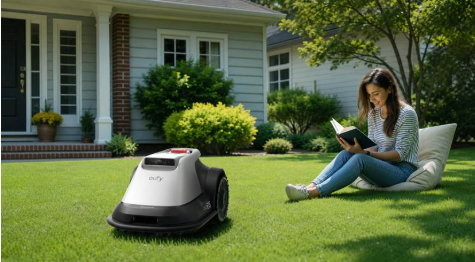
The eufy Robot Lawn Mower E15 is a useful reference for this comparison. It uses vision-based positioning without boundary wire or an RTK station, and its automatic mapping and planned route can be viewed and managed on a smartphone. That removes the boundary-wire line from the worksheet. It does not remove the need to prepare the lawn, place the dock correctly, review the map, or deal with areas the mower should not enter.
That mapping limits matters for divided properties. Each E15 base station supports one map, so a yard that genuinely requires separate maps may need an additional compatible station, adding roughly $400 based on the current list price. Confirm the mapping plan with support before budgeting for extra hardware.
Its fit limits matter more than its feature list. The official page lists a maximum mapping area of 0.2 acres, or about 8,700 square feet, and slopes under 18 degrees. It recommends mostly flat lawns with height variations under 1.2 inches and grass below 3.5 inches before mowing. Dense Zoysia and St. Augustine grass are not recommended. A yard near the acreage limit but outside these conditions needs a different plan, not optimistic math.

Alt: eufy Robot Lawn Mower E15 using app-based automatic lawn mapping without perimeter wire
File name: eufy-e15-app-auto-mapping.webp
Where to Confirm Current Pricing
As of July 31, 2026, the E15 US page listed the mower at $1,799.99 and displayed a $600 coupon, which may reduce the price to $1,199.99 before tax when applicable. Check the eufy robot lawn mower collection for current pricing and availability after narrowing the options by yard size, slope, and installation needs.
Conclusion
A robot lawn mower’s real cost includes the machine, installation, and whether the complete setup fits the property. Before comparing models, measure the mowable grass, map how the sections connect, check the steepest working slope, and price the installation method; the sensible choice is the mower whose limits match the yard, not simply the lowest displayed price.