
Three of these cost nothing. Two are lists of people you would hire yourself. Knowing which is which saves a month.
Last checked September 2026. Every cost, credential, funder and eligibility rule below comes from the organization’s own website or a federal .gov page.
Your father has four doctors. The cardiologist changed a medication in April, the nephrologist does not appear to know, and the primary care office never got the June discharge summary. There is a bill for $1,840 nobody can explain. He is 81, he says he is fine, and you live three states away.
Type “patient advocate” into a search box and what comes back is a mess. A directory, a nonprofit hotline, a startup, a county agency and a private care manager charging by the hour all describe themselves in identical language, and none say whether you pay.
The distinction that matters is not free versus paid. It is what happens after you call. A directory gives you names and steps back: you interview, you hire, you pay. A free program, funded by government or charity, gives you a counselor or a referral inside a set scope. A service assigns you a person and bills an insurer for their time.
Seven options follow, grouped by type and in no particular order within each group. Understood Care is first because it opens the services group, not because it beats the free programs below.
Three different things get called patient advocacy
Work out which you need before comparing names. Do you want a list, a phone call, or a person who takes over? Most families want the third, then find the free option would have solved the actual problem.
- Directories cost nothing to search. The advocate you find is a private professional you hire and pay.
- Free programs are funded by a federal agency or by donors, and their help is bounded: insurance, local services, or one patient population.
- Services assign an advocate and bill insurance. Whether it costs you anything turns on the plan your parent already has.
- Credentials are voluntary. There is no license to be a patient advocate, so certification is the only real filter.
- Almost nobody in the paid half publishes an hourly rate. Get fees in writing first.
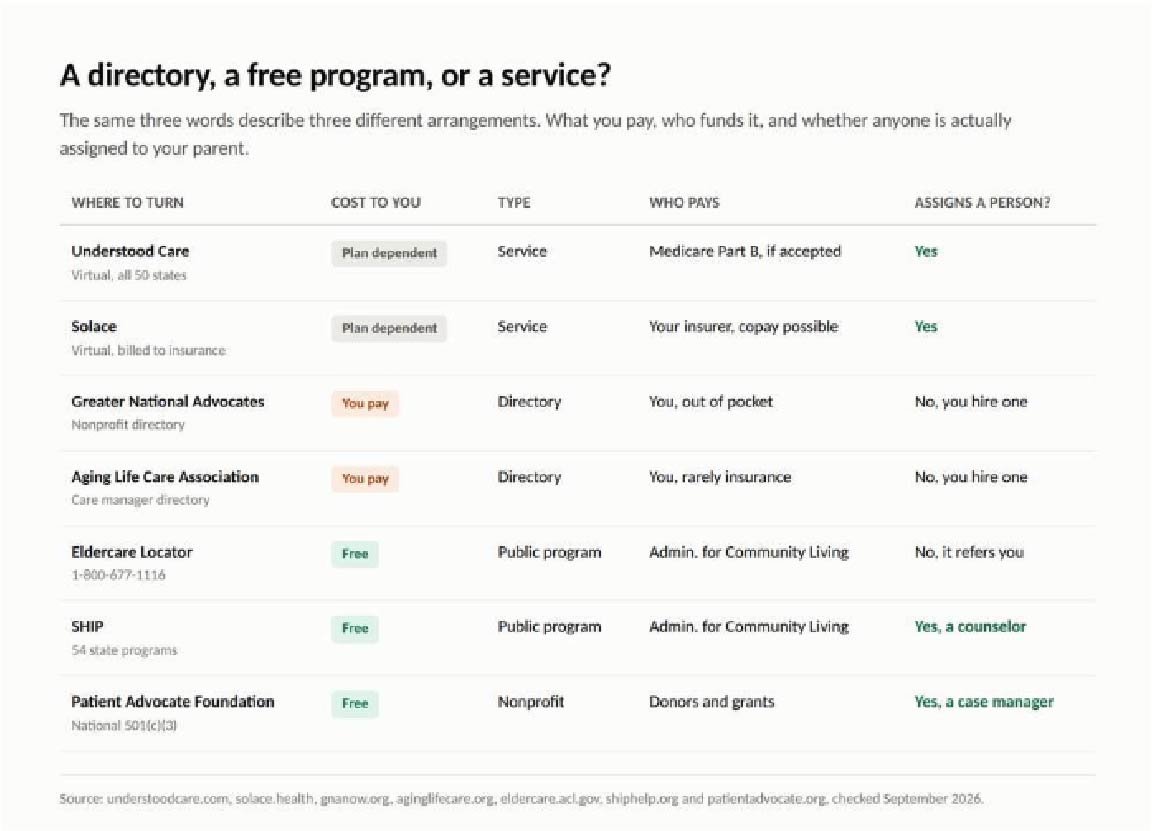
A directory, a free program, or a service?
Understood Care
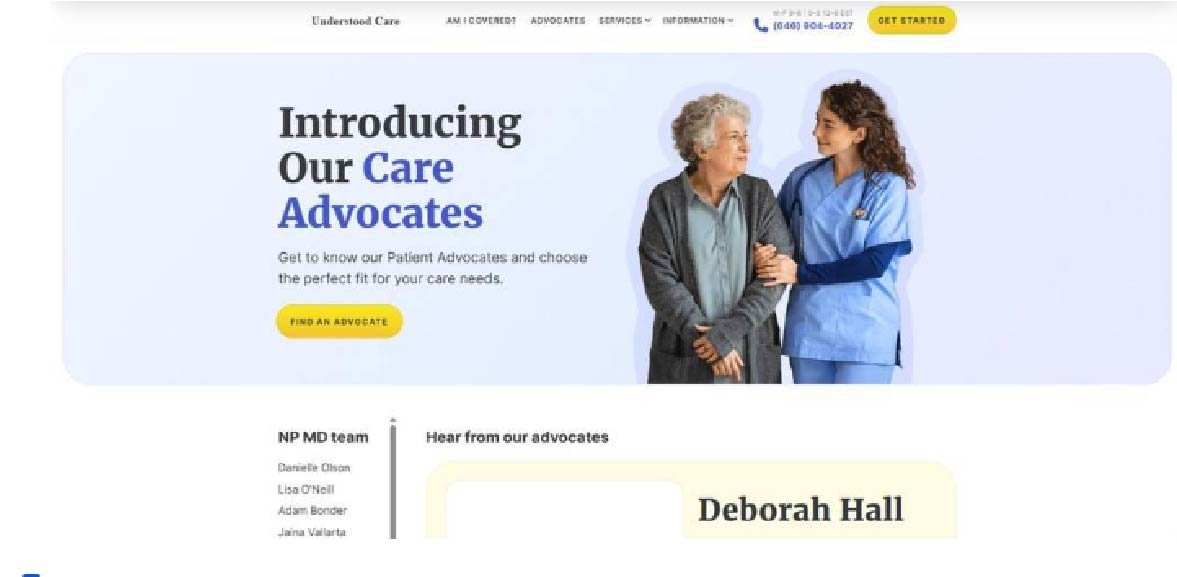
A virtual service that assigns an advocate, with clinical staff behind them: the advocates page lists physicians and nurse practitioners. The work is the unglamorous kind: coordinating between doctors, reviewing bills, cutting medication costs, Medicare applications, transportation. All 50 states, weekdays 9 to 8 and weekends 12 to 8 Eastern.
On cost it is unusually specific. The FAQ says “our services are covered by Medicare for most patients,” that the company “accepts Medicare Part B and many Medicare Advantage plans,” and that it confirms coverage before the first session. Its own roundup of patient advocate services for seniors puts free options like SHIP beside paid ones.
Key strengths
- Billed through Medicare Part B rather than to the family, where coverage is accepted.
- Clinical staff on the team, so a medication question does not bounce elsewhere.
- Nationwide and virtual, useful when the adult child lives far off.
Best for
An older adult on Original Medicare or an accepted Medicare Advantage plan whose care nobody is coordinating.
Worth asking about
Coverage turns on your parent’s own plan, and the FAQ is plain: advocacy is “not yet covered by Medicaid” and “not yet covered by commercial insurance.” It accepts “many” Medicare Advantage plans, not all, so that coverage check decides whether this is an option. No self-pay rate is published, and the service is entirely virtual.
Solace
The same model from a different company, and the closest comparison to the entry above. You describe the situation, take a free assessment call with a Solace physician, and get matched with an advocate, sometimes the same day. Advocates are described as doctors, nurses and care experts working by video and secure message.
The site names United, Humana, Blue Cross Blue Shield, Aetna, Cigna and WellCare among the insurers it works with, and says Solace “is billed directly to your insurance, including Medicare, so most people have no cost out of pocket.” People without coverage can use hourly rates, which are not printed.
Key strengths
- Free assessment call with a physician before any match is made.
- Matching can happen the same day, which helps when a discharge is in play.
- Phone line weekdays 6am to 5pm Pacific, plus 24/7 live chat.
Best for
Families who want a person assigned quickly and whose parent is covered by a large national insurer.
Worth asking about
The FAQ says “eligibility varies by plan” and “depending on your plan, you may have a copay,” so the out-of-pocket answer is unknowable until your plan is checked. Self-pay rates are not published, and you cannot meet an advocate without the physician call first.

Greater National Advocates
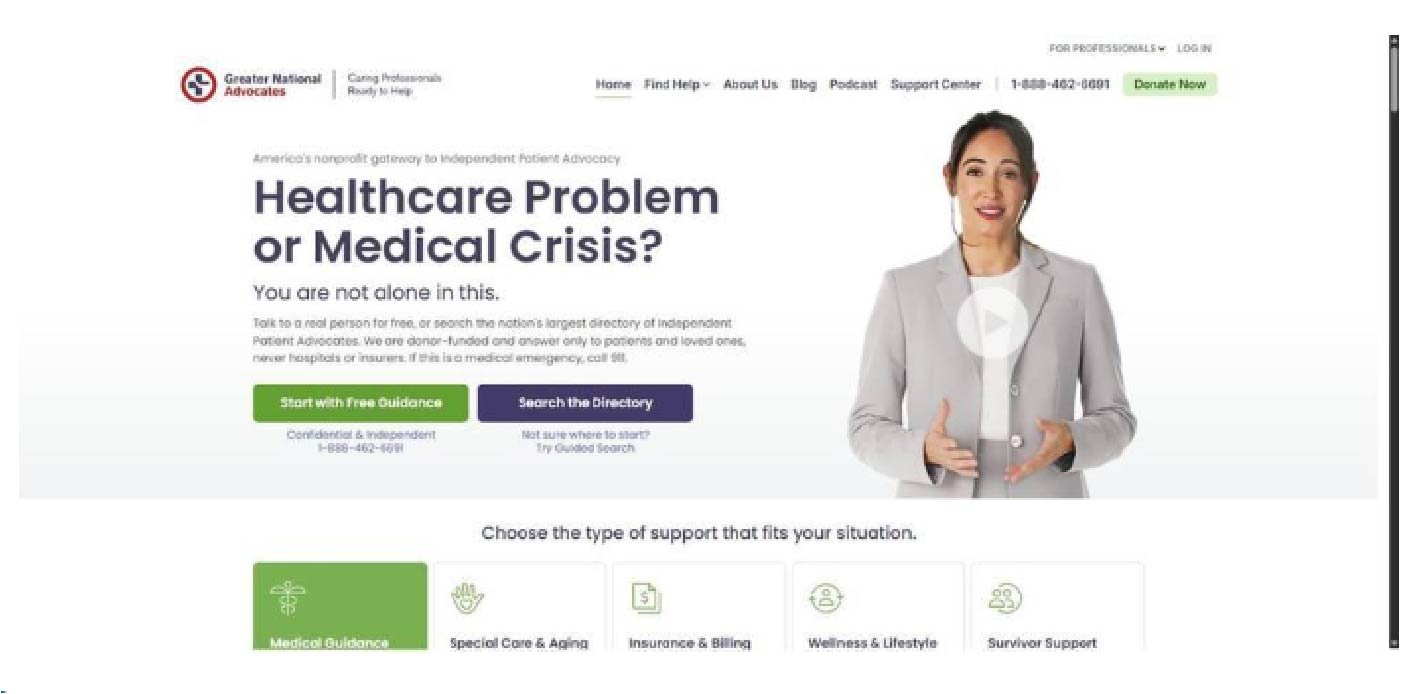
A 501(c)(3) public charity running what it calls “the nation’s largest public directory of Independent Patient Advocates.” Search by location or by specialty, including Special Care and Aging or Insurance and Billing. It is blunt about its independence: it takes “no money from hospitals, insurers, investors, or the advocates we list,” and listing is free to advocates.
Read the FAQ first. GNA states that “currently, most health insurance plans do not cover Independent Patient Advocacy services,” and that fees “vary depending on their experience, credentials, and the specific services they provide.” Some offer free consultations or sliding scales.
Key strengths
- Free to use and independent, with no referral money moving either way.
- Specialty filters that map to real problems, including billing disputes and aging care.
- Shows the Board Certified Patient Advocate credential where an advocate holds it.
Best for
Someone who wants a private advocate with a specialty and is prepared to interview two or three.
Worth asking about
GNA values the BCPA credential but does not require it, and describes no verification beyond agreeing to a code of ethics. It makes no referrals and no endorsements: you interview and decide. The number of advocates listed is not published, so local coverage is unknown until you search.
Aging Life Care Association
The membership body for what used to be called geriatric care managers. An Aging Life Care Professional is closer to a project manager for an older adult’s whole life than to an insurance specialist: assessment, coordination and advocacy across housing, health and daily logistics. Use it when the problem is not a denial letter but a sense things are slipping.
Members need a degree in a related field such as nursing, social work, gerontology or psychology, plus two years of post-degree supervised paid experience in the last ten years, or three if the degree is in another field. Advanced Professional members hold a CMC, CCM, C-ASWCM or C-SWCM certification, and complaints go to a conduct committee.
Key strengths
- Education, experience and certification requirements that are published and specific.
- A complaints process, which almost nothing else in this field offers.
- Local professionals who will generally go to the house and to appointments.
Best for
A parent still at home, where the questions are about safety, housing and daily support rather than insurance.
Worth asking about
ALCA publishes no rates, saying only that “rates vary by location and experience, and may not be covered by insurance” and that “fees should be provided to the client/responsible party in writing prior to services starting.” Member counts by region are not published, so rural coverage may be thin.
Eldercare Locator
The federal front door, and the most underused number here. It calls itself “a public service of the Administration for Community Living connecting you to services for older adults and their families,” reachable at 1-800-677-1116 and also by text, video, email and chat. Mostly it routes you to your Area Agency on Aging.
Those agencies are the part most families have never heard of. More than 600 exist, established under the Older Americans Act in 1973, and per USAging they handle in-home support, transportation, benefits counseling and meals, plus respite for caregivers.
Key strengths
- Free, federal, and covering the whole country through one number.
- Connects to practical things, meals, rides and home support, not paperwork.
- Treats the caregiver as someone who also needs help.
Best for
The first call, before you have decided what help you need, especially when you live somewhere else.
Worth asking about
The Locator refers, it does not advocate. Nobody here will call the cardiologist or fight a bill. What you get after the handoff depends on the Area Agency serving that county, and what each of the 600-plus agencies offers is not published in one place.
Patient Advocate Foundation
State Health Insurance Assistance Program
SHIP is not one organization but 54, one in each of the 50 states plus Puerto Rico, Guam, the District of Columbia and the US Virgin Islands. They provide “local, in-depth, and objective insurance counseling and assistance to Medicare-eligible individuals, their families, and caregivers,” and are “federally funded by the Administration for Community Living.”
Counselors handle enrollment, coverage changes, programs that cut out-of-pocket costs, how a supplemental policy fits with Medicare, and appeals or complaints. The funding is the point: nobody earns a commission on which plan your mother picks. On cost the site is unambiguous, “there is no cost to consumers to use SHIP services.”
Key strengths
- Genuinely free, with a federal funder rather than an insurance-industry one.
- One-on-one counseling, not a scripted call center.
- Covers appeals and complaints, not only plan selection.
Best for
Anything where the question is about Medicare: a denial, a plan change, a surprise cost, an Extra Help application.
Worth asking about
The network runs substantially on trained volunteers, so depth and wait times vary by state and get worse during open enrollment. The scope is insurance. A SHIP counselor will not coordinate your father’s four doctors or chase his discharge summary.
Patient Advocate Foundation
A national 501(c)(3) providing “case management services and financial aid to Americans with chronic, life threatening and debilitating illnesses.” Case management is “free, one-on-one support.” Case managers work on getting treatment approved, appealing denials, applying to copay and premium programs, and Social Security Disability Insurance. The helpline is 800-532-5274, weekdays 8:30am to 5:00pm Eastern.
One thing to know going in: the foundation announced a merger with the PAN Foundation in March 2026, the combined organization operates as Patient Advocate Foundation, and its unified aid program, TotalAssist, launched July 1, 2026.
Key strengths
- Free case management from a person who stays on the case, not a one-off answer.
- Handles appeals, copay programs and SSDI alongside access to treatment.
- Financial aid funds sit under the same roof.
Best for
A parent in active treatment for a serious illness where denials or the cost of care are the immediate crisis.
Worth asking about
The eligibility rules are narrow and exclude a lot of ordinary aging: a confirmed diagnosis or testing underway, active treatment starting within 60 days or finished within six months, and US citizenship or permanent residency. Capacity is capped daily, and the instruction is to “call us back the next day.”
What the three types feel like once you call
The free programs answer questions, the directories hand you a shortlist, and the services take the task. The trap is assuming the most expensive option is the most capable, when a SHIP counselor can often settle a denial in one conversation a paid advocate would bill several hours for.
The reverse trap is just as real. If nobody is coordinating anything, a referral hotline will not fix it: coordination is ongoing work, a referral is one act. That gap is what the assigned-advocate services fill.
Which door to knock on first
Why any of this can be billed to Medicare at all. Greater National Advocates notes in its FAQ that as of January 2024, Medicare and some state Medicaid programs introduced billing codes for patient navigation, while adding that independent advocates still face practical obstacles billing them directly. That is what lets a service bill a plan instead of a family, and why the same work bought through a directory is usually out of pocket.
Questions to ask before you sign
- Will you bill my parent’s plan, and can you confirm coverage in writing before the first session? The paid services here say they check first. Hold them to it.
- What is the self-pay rate if the plan is not accepted, and is the first consultation free? Almost nobody publishes this.
- Who will I work with, what is their background, and do they hold a BCPA, CMC, CCM or a clinical license?
- Is this person virtual only, or will they attend appointments and visit the home?
- What happens when it ends? Ask about any minimum commitment and who holds the records afterwards.
Where to start
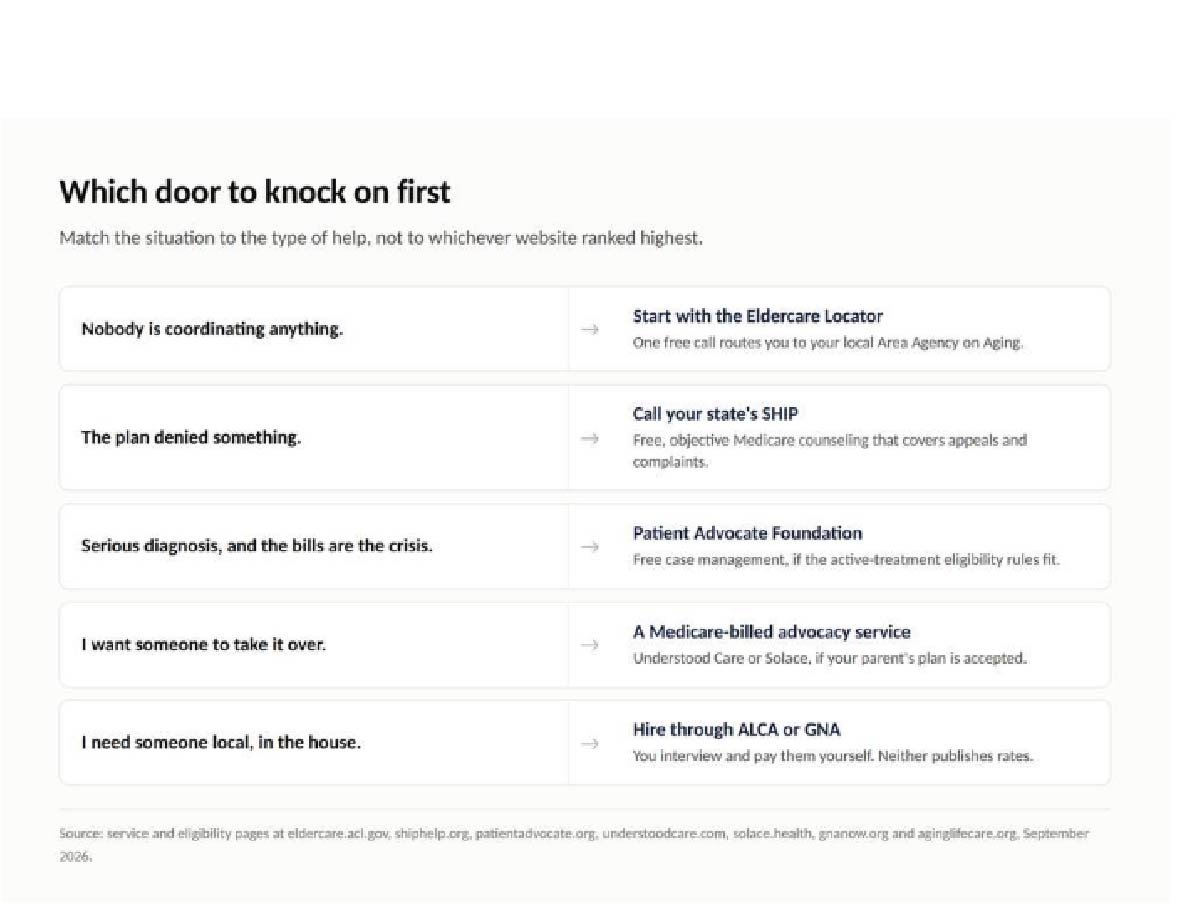
If you do not yet know what kind of help you need, start with the calls that cost nothing. The Eldercare Locator at 1-800-677-1116 finds the Area Agency on Aging in your parent’s county, and your state’s SHIP will take anything confusing about Medicare. Those two calls tell you what exists locally.
If the work is ongoing and nobody is doing it, you need a person rather than a phone number. Check whether a Medicare-billed service accepts your parent’s plan, or search a directory, interview two or three people and get the fee agreement in writing first. The one thing not worth doing is what most families try first: being the advocate yourself from three states away with a spreadsheet.
Facts here were taken in September 2026 from each organization’s own website or from federal .gov sources, and quoted where the wording mattered. Rates, accepted plans and eligibility rules change without notice, so confirm anything cost-related with the organization before you commit.