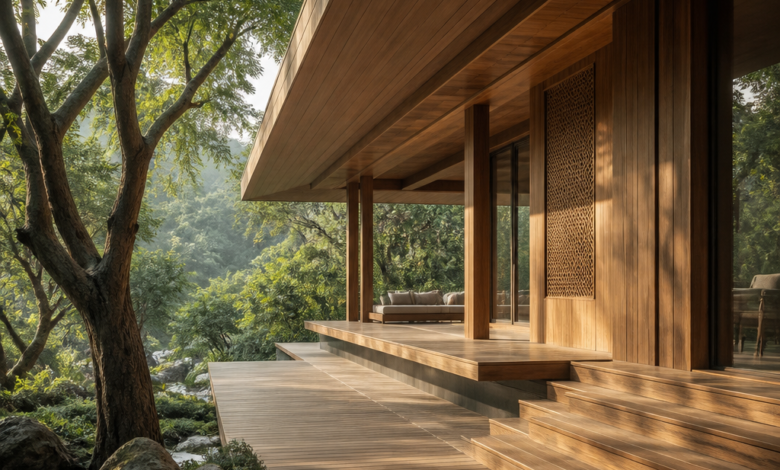
Wood has shaped human civilization for millennia. From the earliest shelters to the grand timber-framed cathedrals of medieval Europe, this material has been inseparable from how we build, live, and express culture. Yet the 21st century is forcing a profound rethinking of what “wood” actually means in architecture and construction. As sustainability pressures mount and material science accelerates, the industry is navigating a fascinating crossroads — one where ancient forests, engineered panels, and even laboratory-grown cellulose are all competing for a place on the modern building facade.
Why Wood Remains Central to Architectural Identity
There is something deeply intuitive about wood in the built environment. Its warmth, texture, and organic variability create spaces that feel inherently human. Biophilic design — the principle that humans thrive when connected to natural elements — has elevated timber and wood-grain aesthetics to a premium status in contemporary architecture. Offices, residential towers, cultural institutions, and retail spaces are all leaning into wood’s visual language as a counterpoint to the cold uniformity of glass and steel.
But natural timber comes with well-documented challenges. It warps, weathers, cracks, and demands significant maintenance when exposed to the elements. Sustainably sourced timber is also a finite resource, and the logistics of harvesting, treating, and transporting large volumes of structural or cladding timber carry a meaningful carbon footprint. These realities have pushed architects and material engineers to explore alternatives that preserve the aesthetic appeal of wood while eliminating its vulnerabilities.
The Rise of Wood-Grain Aluminum Panels
One of the most significant shifts in facade design over the past decade has been the growing adoption of wood-grain aluminum panels. These engineered products use advanced sublimation printing and powder-coating techniques to replicate the visual depth and grain patterns of natural timber with remarkable fidelity. The substrate, however, is aluminum — a material that is dimensionally stable, fire-resistant, and virtually impervious to moisture and UV degradation.
Architects working on high-rise residential buildings, commercial complexes, and public infrastructure projects have increasingly turned to this solution when timber’s performance limitations become prohibitive. As explored in detail by industry analysis on why architects are replacing timber facades with wood-grain aluminum panels, the decision is rarely purely aesthetic — it is driven by lifecycle cost analysis, fire code compliance, and the demand for low-maintenance exteriors that retain their appearance over decades without refinishing or replacement.
The environmental calculus is also more nuanced than it first appears. Aluminum is highly recyclable, and modern production increasingly draws on recycled content. When weighed against the repeated maintenance cycles, chemical treatments, and eventual replacement of natural timber cladding, aluminum panels can represent a more sustainable choice over a building’s full lifespan.
Performance Meets Aesthetics
The technology behind wood-grain aluminum has matured considerably. Early iterations were unconvincing — flat, repetitive patterns that read as obviously synthetic at close range. Contemporary manufacturing processes produce panels with variable grain depth, color gradation, and even tactile surface texture that can genuinely challenge the eye. Specifiers now have access to profiles that mimic cedar, oak, walnut, teak, and a range of exotic species, all without the sourcing complications or ecological concerns associated with harvesting those materials at scale.
Lab-Grown Wood: The Next Frontier
While engineered panels address the performance gap in facade applications, a more radical innovation is emerging from research laboratories: wood grown entirely outside of a forest. Scientists have demonstrated the ability to cultivate wood-like cellulose structures in controlled laboratory environments, bypassing the decades-long growth cycles of trees entirely. This approach, still in its early stages, could eventually allow builders to specify wood with precise mechanical properties, custom dimensions, and minimal waste — all without cutting down a single tree.
According to groundbreaking research into lab-grown wood and its implications for sustainable construction, researchers have successfully grown wood-like plant tissue in laboratory conditions by manipulating the hormones that regulate cell growth. The resulting material can be tuned for density and stiffness, opening the door to a future where structural and decorative wood components are manufactured rather than harvested. While commercial viability remains years away, the trajectory is clear: the definition of “natural” materials in construction is being fundamentally rewritten.
Implications for Sustainable Design
The convergence of engineered wood alternatives and biotechnology-driven material innovation is reshaping how sustainability is understood in the built environment. It is no longer sufficient to simply specify FSC-certified timber and consider the job done. Architects, developers, and sustainability consultants are now expected to evaluate materials across their entire lifecycle — from raw material extraction or cultivation, through manufacturing, installation, maintenance, and eventual end-of-life disposal or recycling. Wood-grain aluminum and lab-grown cellulose both represent attempts to optimize this lifecycle in ways that conventional timber cannot.
TarRiver: Connecting Material Innovation to Real-World Projects
Navigating this rapidly evolving material landscape requires expertise, industry relationships, and a clear understanding of how emerging products perform in real-world conditions. TarRiver brings that depth of knowledge to clients working across the construction and architectural sectors, helping teams make informed decisions about material selection, supplier sourcing, and project specification. In an environment where the options are expanding faster than most practitioners can track, having a knowledgeable partner to cut through the noise is increasingly valuable.
Whether a project calls for traditional timber detailing, high-performance aluminum cladding systems, or forward-looking sustainable materials, the ability to evaluate trade-offs objectively — rather than defaulting to convention or chasing trends — is what separates good outcomes from great ones. That kind of rigorous, evidence-based approach to material selection is at the core of what serious construction professionals need today.
Rethinking What We Mean by “Natural”
Perhaps the most important shift happening across architecture and construction is a philosophical one. The instinct to equate “natural” with “sustainable” or “authentic” is being challenged by the realities of resource depletion, climate change, and material science. A wood-grain aluminum panel that lasts 50 years without maintenance may ultimately be a more responsible choice than a timber facade that requires chemical treatment every five years and replacement within two decades. A piece of lab-grown wood that requires no forest land and generates no logging waste may eventually be more “natural” in its ecological impact than conventionally harvested lumber.
These are not comfortable conclusions for an industry with deep cultural attachments to traditional materials. But they are necessary ones. The buildings being designed and constructed today will define the urban landscape for generations. Getting the material decisions right — balancing aesthetics, performance, sustainability, and cost — has never mattered more.
Conclusion: A Material Revolution Already Underway
Wood’s role in architecture is not diminishing — it is transforming. The grain, warmth, and organic character that make timber so compelling remain as desirable as ever. What is changing is the range of technologies and materials capable of delivering those qualities, and the sophistication with which the industry evaluates them. From precision-engineered aluminum cladding systems to cellulose cultivated in a laboratory, the future of wood in construction is being written right now — and it looks nothing like the past. For practitioners willing to engage seriously with these developments, the opportunities are significant. For those who are not, the risk of being left behind is equally real.